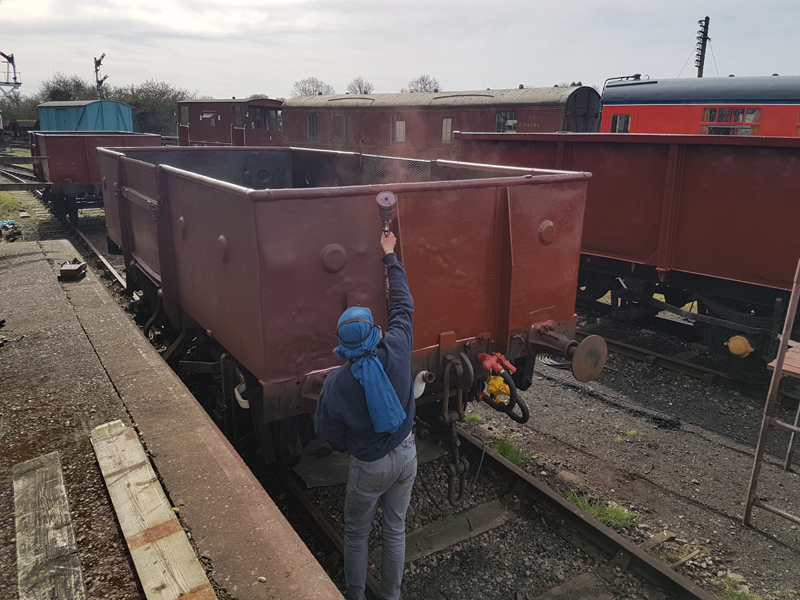
Tag: Vehicle Profile

  • Vehicle Profile #8 Scammell Scarab

    Vehicle Profile #8 Scammell Scarab

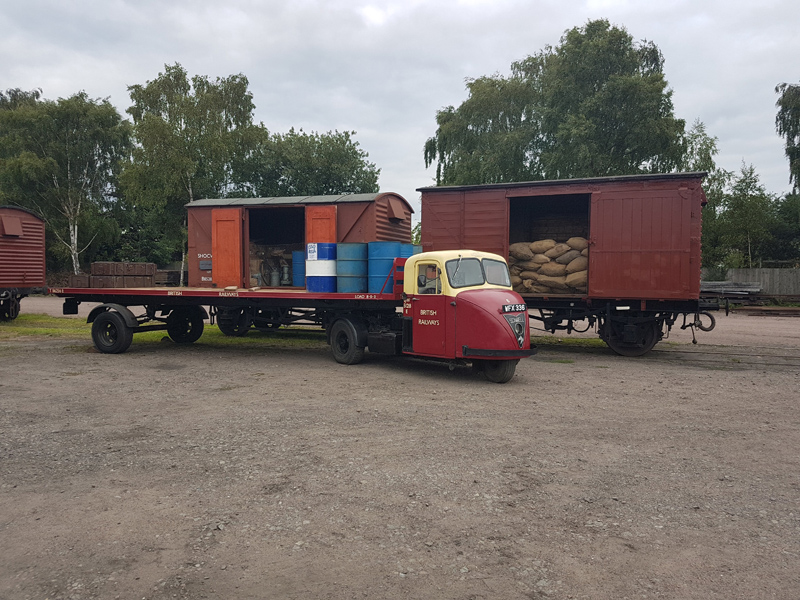
    This story begins in June of 1953 at the Scammell Lorries Ltd factory, Tolpits Lane, West Watford, leaving the factory a 6T Scammell Scarab carrying the military registration 20 AN 52 and delivered to the Royal Air Force on the 26th June 1953.
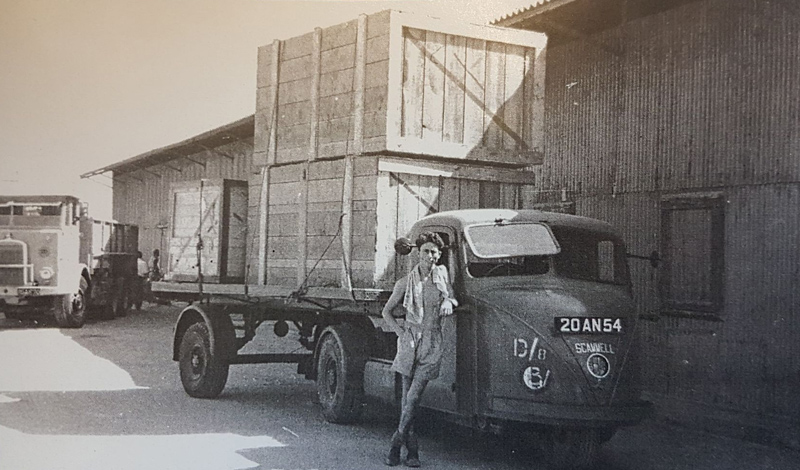
    RAF Scarab 20 AN 54 sister to our very own 20 AN 52

    On the 17th July 1953 she was allocated to 14 Maintenance unit at RAF Carlisle, an aircraft equipment depot. This was followed by further moves on the 26th May 1955 to 35MU at RAF Heywood another aircraft equipment depot, then to 7MU RAF Quedgeley on the 4th Jan 1956, 250 MU RAF Bircotes on 31st Jan 56 before her final movement into storage at RAF Andover on 8th October 1957 being sold off to an ex forces vehicle dealer in Ely Cambridgeshire sometime after 22nd May 1970. When placed on the disposal list in 1970 she had accrued no more than 9000 miles over 17 years of service.

    The story picks up again in the Early 1980s when two chaps by the name of Dave Wood and Martyn Upson bough the vehicle from the Ely dealer. It arrived running on 3 cylinders and they successfully worked to rectify this.
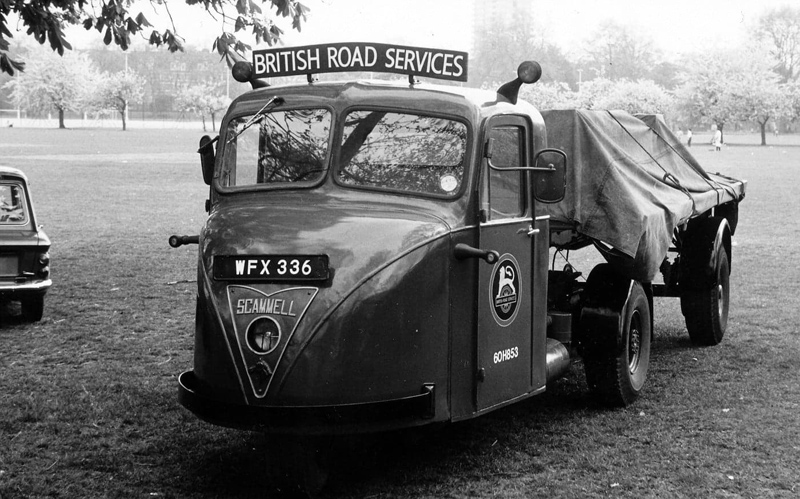

    They decided to paint her in to a British Road Services livery, although a fictitious Red by mistake, she was registered WFX 336 in November 1982. In 1984 she took part in that years Brighton Run, using an Hilman Imp as a support vehicle. She also stared in an episode of One by One, filmed in the late 1980s the series followed the career of an international veterinary surgeon. With raising petrol prices a diesel Scarab was bought and she was sold to a Roger Tuplin, Roger bought a trailer, a genuine BR flat from Kings Cross station and after a number of years then sold her to a member of the Nene Valley Railway who fitted the insulated body from a Ford D series lorry to the trailer.

    She then exchanged hands once again and she found ownership in Crowland, Lincolnshire and it was from this location our involvement begins.

    Towards the end of 2019 Dave Bower and I, along with Jack Arthur Shaw came together and purchased the vehicle, now christened Madge, she arrived at Quorn & Woodhouse on the 19th December 2019.
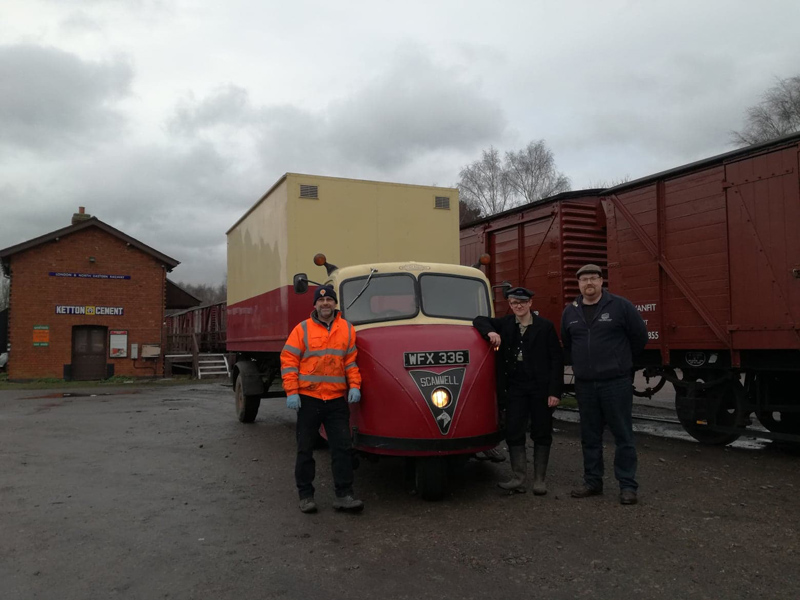
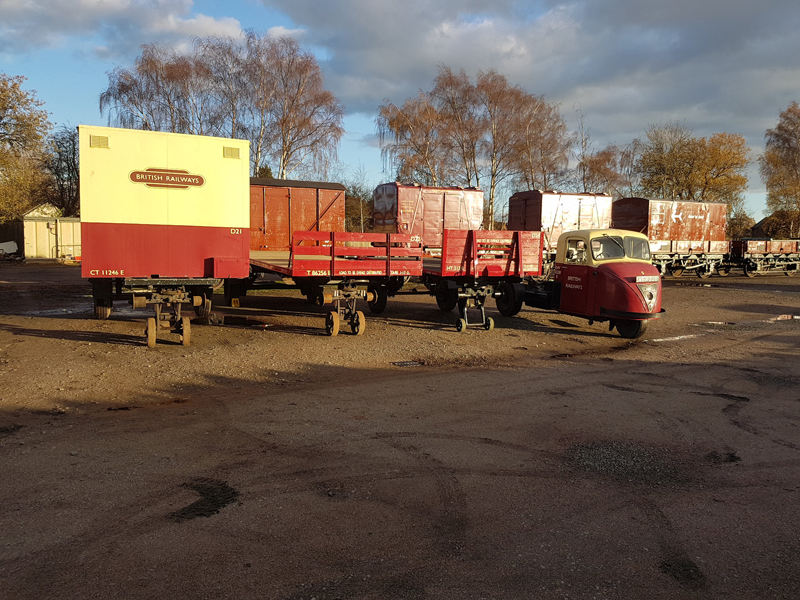
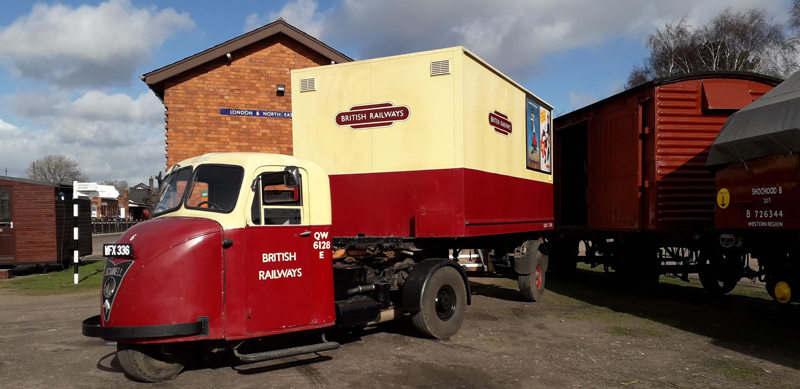
    She arrived to us in a pseudo British Railways livery of Blood and Custard minus lettering and a little more Crimson that prototypical. Also part of the deal was the insulated body trailer.  This had been kitted out as a living van and having spent a couple of nights in it I can state it is both warm and comfortable.  Over our first Christmas we removed her indicators and painted the fuel tank, vacuum reservoir, oil bath, engine cover and rear wheels black, more in keeping with a BR Scarab, we also applied lettering and the fictional number QW 6128  E (6 tons and part of the station postcode) This was in preparation for her first public appearance at the GCRs Winter Gala 2020. This went down very well and with a last-minute Photo Charter appearance covering for poor lighting at the preferred location, her usefulness on-site was cemented.
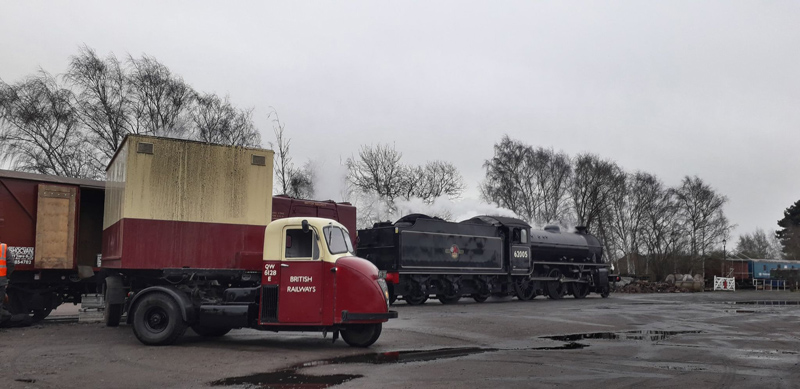
    A number of jobs continued on the trailer including adding BR totems, painting poster areas to the correct 40″x 60″ and adding the fictional number T 11246 E (Owners birthday dates).
    Our thoughts, however, turned towards the desires for a flat trailer.  During a chance conversation whilst at work, a friend of one of our colleagues happened to have “a trailer with one of those couplers”.  After viewing and negotiation, the former silage trailer and dolly arrived at Quorn in late January of 2020.  This needed a little more than lettering and with the dolly uncoupled, a new floor, a full repaint, and the manufacture of a headstock it was first coupled to the Scarab in July 2020 after the first national lockdown. The Scarab and trailer combo then spent every subsequent open weekend on display until October.

    With the completion of my 1958 built Aluminium Container, it was placed on the flat trailer for a number of weekends for public display before being loaded on to the Medfit

    October saw another charter with the whole team and enactors in period dress and Madge joined by my Morris Minor Van, we created a number of cameos and succeeded in our aim of recreating a genuine steam era goods yard.
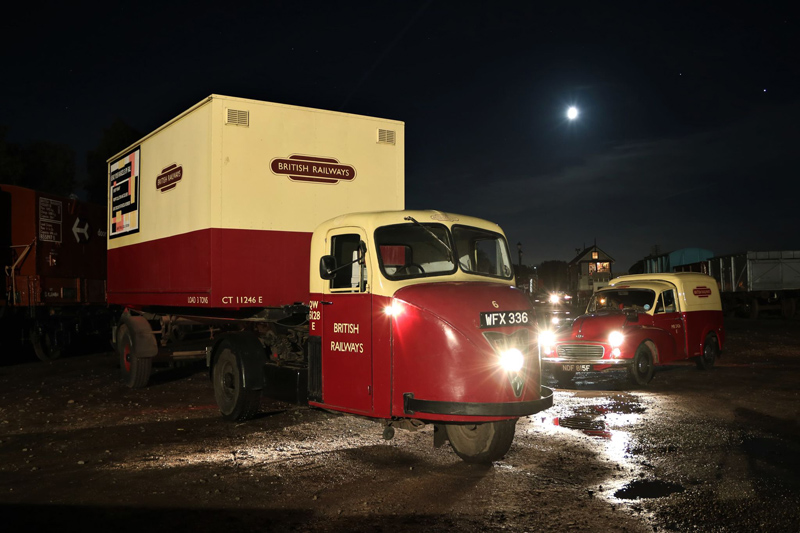
    The desires for a shorter trailer came to ahead.  With thanks to John Giles, of the Mechanical Horse Club, for his patience and advice, I completed the purchase of a Taskers 15ft trailer, it being repainted from Army Green to BR Crimson.

    Our current fleet with a 3:1 ratio

    The Scarabs are of course synonymous with British Railways and in 1958 over 7500 Scarabs and 30,000 trailers were in use with the company, that’s a ratio of 4 trailers to each Scarab. The whole ethos of the vehicle was to replace the horse providing a stronger, less labour intensive alternative whilst maintaining the manoeuvrability of a real horse.

    That concludes the look at our resident Scarab and our lockdown features, with great delight we have been asked to support the GCRs aims to return to passenger operations on the 17th April 2021. Our fleet of engineering vehicles are overdue routine maintenance and this is to be our focus to support re-ballasting work required in the single line section as well as other engineering requirements to get the railway ready for services to resume.
  • Vehicle Profile #7 – Brakevans

    Vehicle Profile #7 – Brakevans

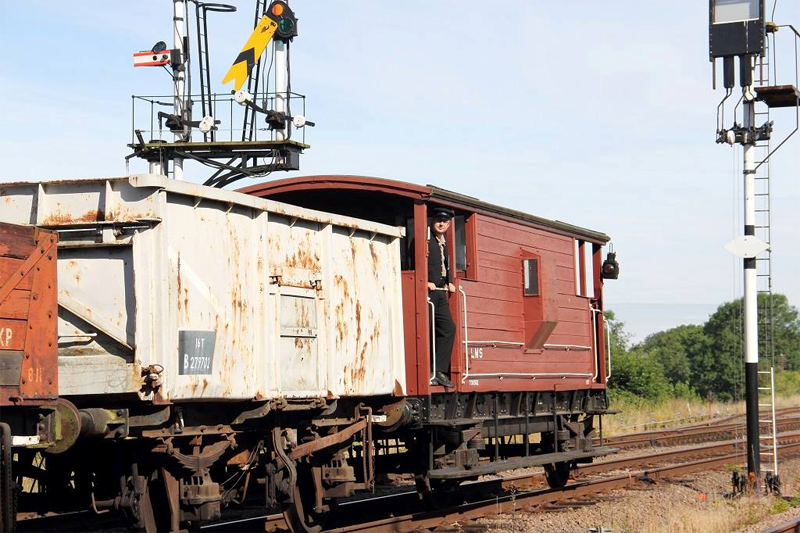
    I though it best to give both Matt and Ross a break this weekend, so for the first time its me, Dave Bower, completing a weekly update, this week we focus on the van at the back of the train.

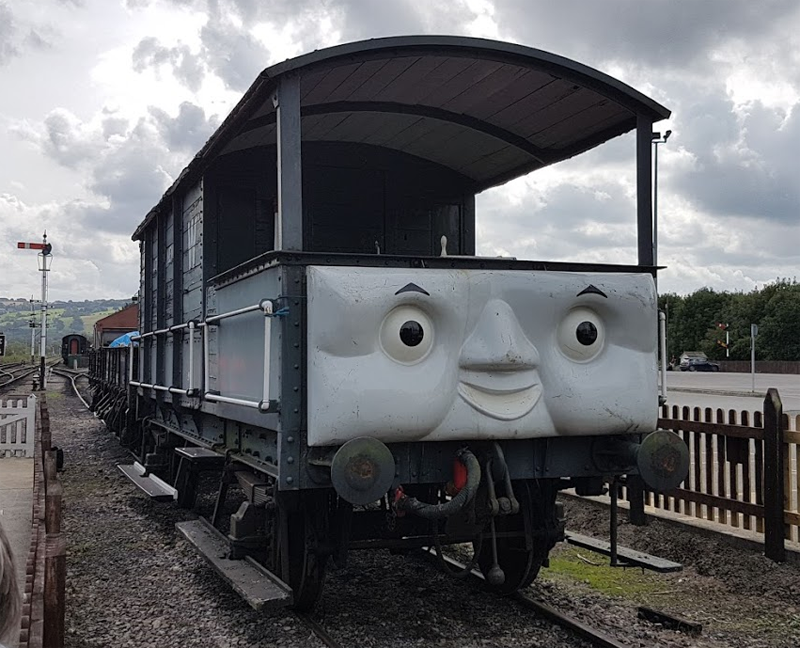
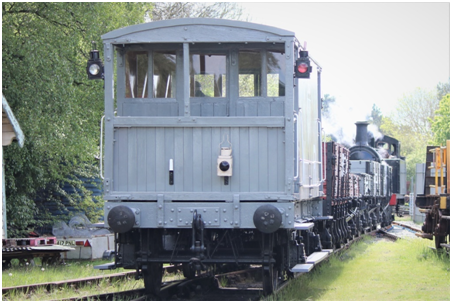
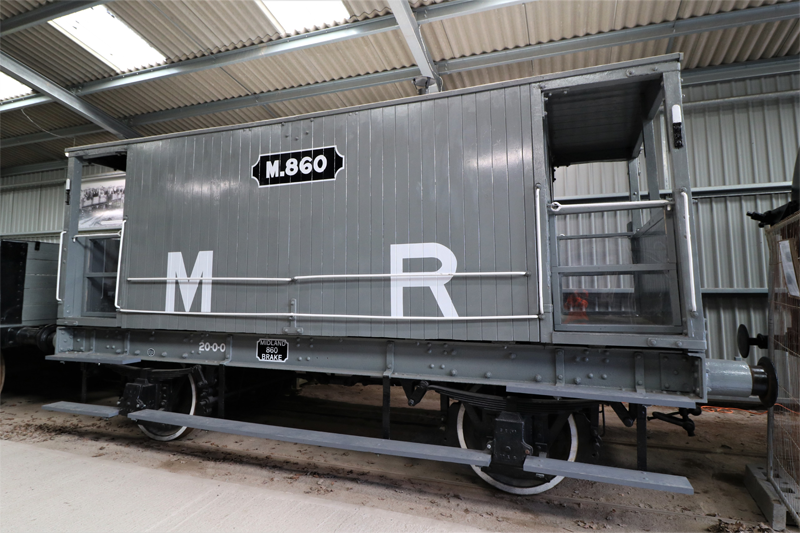
    As early as the 1840s wagons or coaches were specifically adapted for a Guard, this was someone employed by the railway to protect the valuable stock carried by the train from theft or vandalism. As these ‘unfitted’ trains (vehicles not fitted with an automatic brake controlled by the locomotive) increased speed and weight the Guards took on more duties relating to the actual safe running of the train. By the 1870s what we now know as ‘brake vans’ were in use and in the case of goods trains meant the Guard was on hand to take action in the event of a breakdown, accident or the more common event of train separation. As the speed of goods trains still continued to increased the purpose of the brake van and the guard’s duties developed further with the Guard using the brake van’s handbrake to assist with keeping the train under control on downwards gradients or whenever he could see that the locomotive’s crew was attempting to slow the train. The Guard could also use the handbrake to keep the loose couplings taut between unfitted wagons  minimising the risk of broken couplings and if no locomotive was attached hold the train with the brake vans brake.

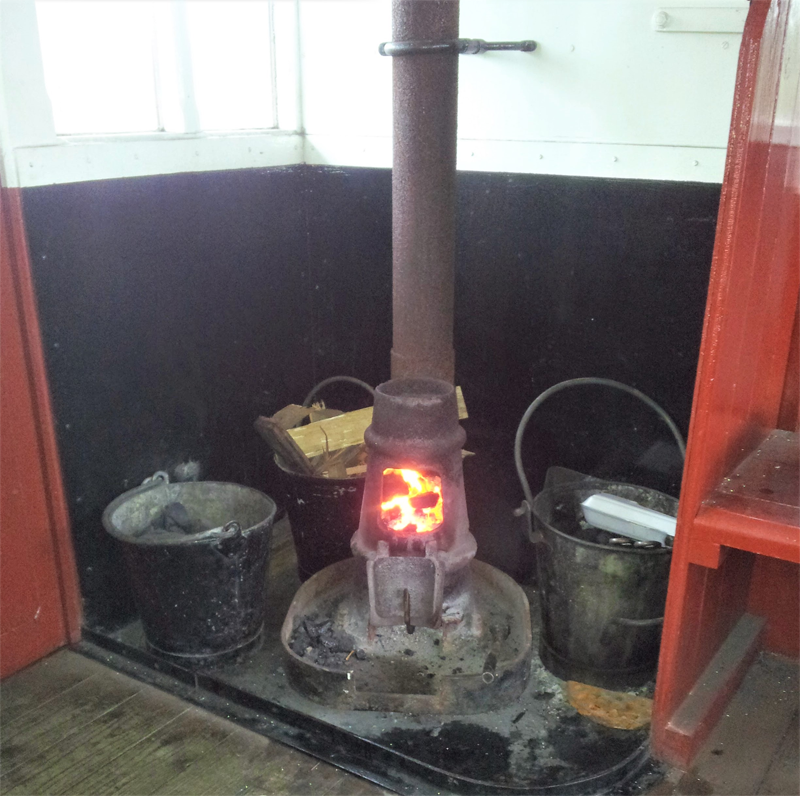
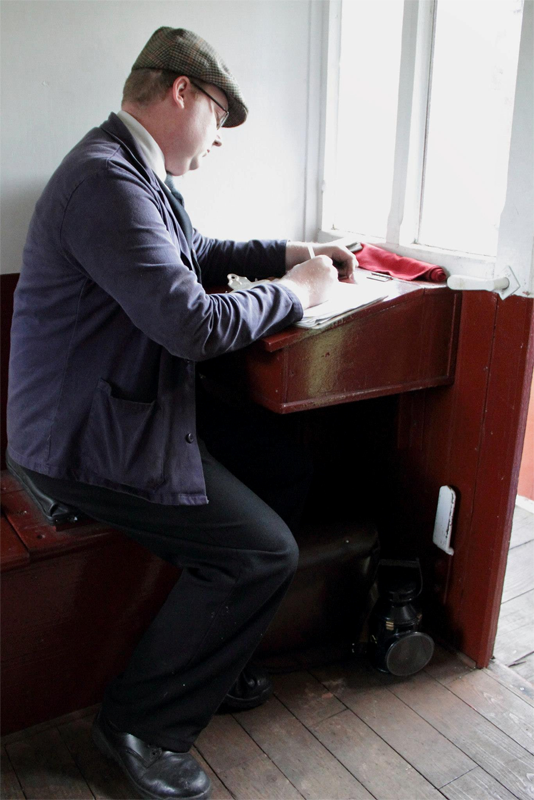
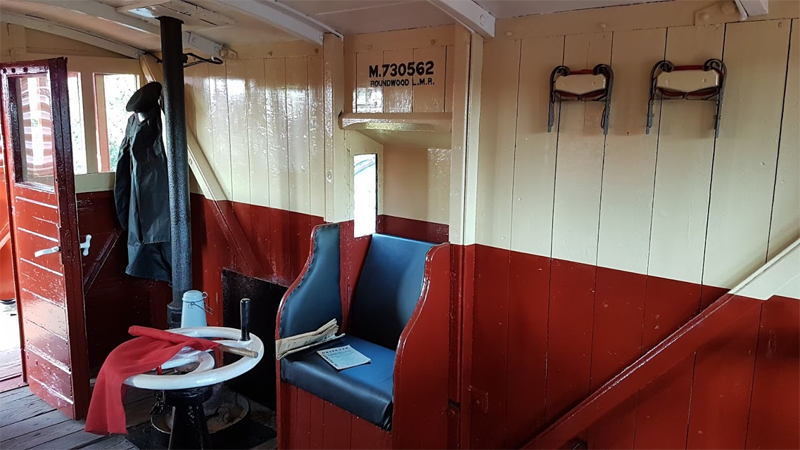
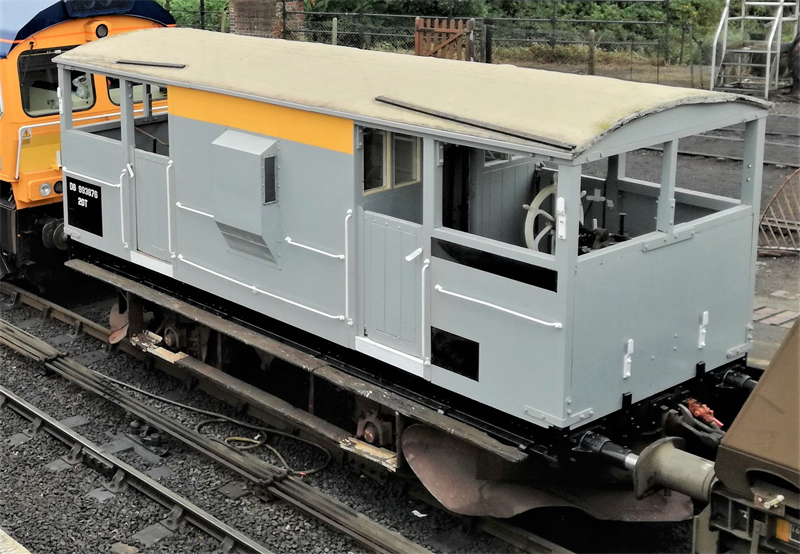
    Different types of brake vans evolved, some with single verandas and others with a veranda at each end, normally with a safety bar or half height door to each side. In most cases a significant amount of ballast is installed in the form of steel, cast iron, water tanks or more commonly during and after the wars concrete, this was built into the underframe to increase the available braking effort applied by the van. Step boards are fitted, sometimes along the full length of the van along with multiple grab handrails for the use of the Guard or Shunter when required. Inside the van’s interior most are fitted with a coal stove for the guard’s heating and cooking needs, with a hanging rail above with hooks on for drying wet clothing. As well as a desk to complete the all important paperwork required by the company.

    Most brake vans were not built with train brakes, only a wheel operated handbrake; because they were designed to be used at the rear of un-fitted trains. Some are however vacuum through-pipe fitted, in which case a brake application valve is installed inside the brake van but towards the end of brake van use between the late 60s and 80s vacuum and even air brakes were fitted.

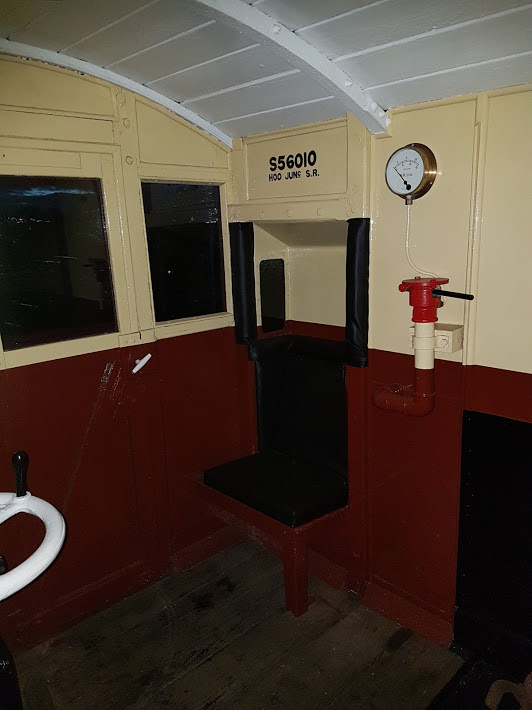
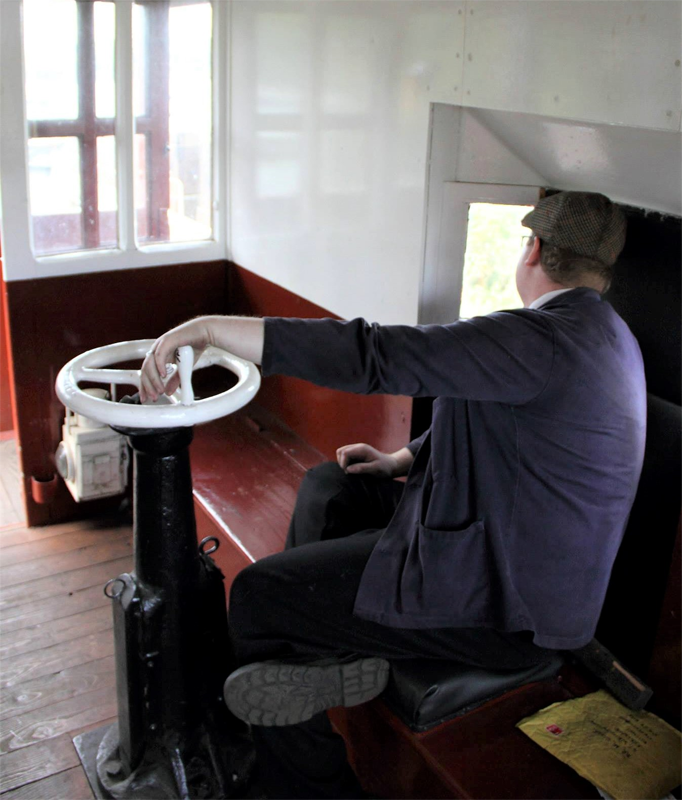
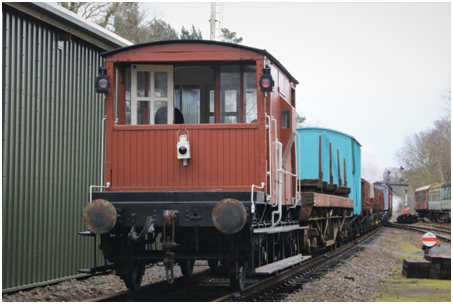
    Duckets on each side of the brake van provide the guard with safe viewing of the train , signals ahead and the lineside without the need for leaning out of the brake van. The seats by each ducket also have side and back pads which provide the guard with some useful support in the event of jerks or coupling snatches. The handbrake wheel is installed within easy reach of the guards ducket seats.

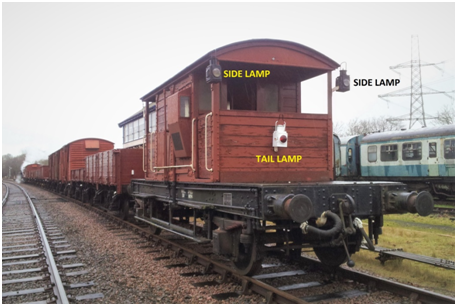
    Lamp irons are fitted to carry a tail-lamp and also side lamps. It was the guard’s duty to check that the tail and side lamps were on-board, filled with paraffin, the wick trimmed.

    Trains that are not fitted with the automatic brake throughout, i.e. unfitted, must in addition to the tail lamp carry side lamps. With one exception, it is not a requirement to display side lamps on freights when the automatic brake is connected and in use on all vehicles on the train. This was a LNER / BR Eastern rule and later adopted by all of BR in the 1980s

    Side lamps are required to be lit at all times. They are designed to show a white aspect towards the locomotive to inform the crew that the train is still complete and following. if however the lamps were unlit, a red aspect could be shown via light shining through the rear red filter.  This could be misread by the crew as a stop signal. In a genuine emergency the Guard would rapidly apply and release the hand brake, jerking the train to grab the crews attention and display a separate red flag or light. If the train was fitted with a brake pipe the full length of the train, then all the Guard needed to do was release the vacuum or apply the air brake.

    To the rear two red side lamps are displayed for trains operating on main or single lines.

    or, one red light on the side furthest from the main line and one white light nearest for trains in loops adjoining main lines and running in the same direction. This also applies on double lines signalled for trains in both directions whilst travelling in the reverse direction.

    Side lamps should be removed when in sidings.

    There is a story of an express trains crew leaping from the foot plate of a loco when the Guard of a goods forgot to swap his mainline side lamp for a white.  Reputedly a down express came through Loughborough Central and saw in the distance beyond Empress Road bridge the 3 red tail lamps of a goods,  the driver applied the brakes and both he and the fireman leapt from the cab. The driver received cuts and bruises the fireman however hit the bridge and was killed. The Goods was in the Down Goods loop clear of the express waiting to pass.  How true the story is regards to location I cannot verify but I’m sure it is likely to have happened even if the outcome did not involve a fatality.

    The Guards preparation duties include checking that all the necessary equipment was in the brake van.

    • A shunting pole which is a wooden pole about 6 feet long with a twisted hook on the end, this is used to couple couplings without the guard having to climb between the wagons,
    • A brake stick, used to lever down the handbrakes of wagons,
    • Two pairs of track circuit clips, for use in emergency situations to indicate to the signalman that a train is occupying that section. They are clipped over both rails of a track-circuited line so as to short circuit the track in the event of an incident or accident,
    • A spare vacuum hose,
    • Wheel scotches (minimum 2),
    • Fire extinguisher and fire bucket,
    • Side Lamps (x 2),
    • Tail Lamp,
    • Red and Green flags,
    • Paraffin for the lamps,
    • Coal and kindling to light the stove fire.

    Other uses of brake vans includes those fitted with ballast ploughs under each end, that are used to assist with distribution of ballast and clearing the rails during ballast drop runs when at the rear of a train of bottom discharge ballast wagons such as Dogfish or Catfish type wagons.

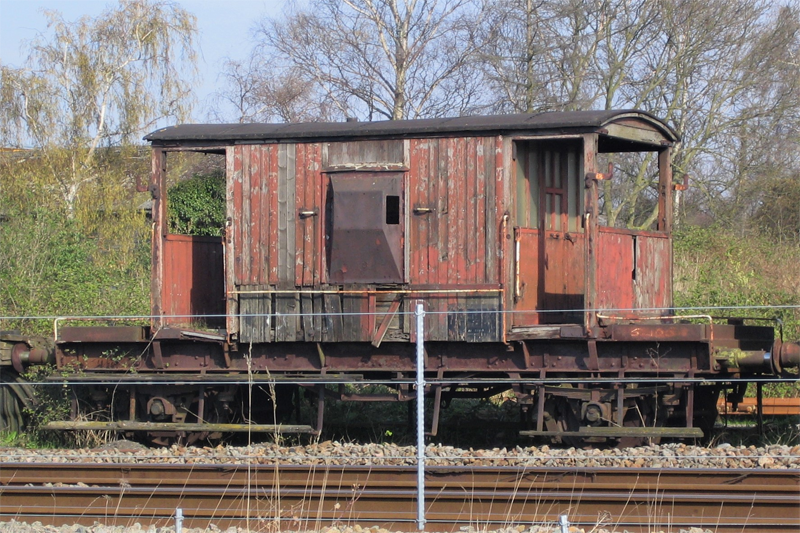
    As the running of unfitted trains dropped during the 1970s and finished in the early 1980s, many brake vans were withdrawn, shunted to the end of sidings and left to rot because they were filled with concrete so had to be dealt with differently when it came to scrapping. This probably helped provide more of a choice for the preservationists.  Nick has regaled us with stories of brake vans being worked from scrap yard to scrap yard as none were too keen to break up the vehicles as they were mostly concrete and wood.

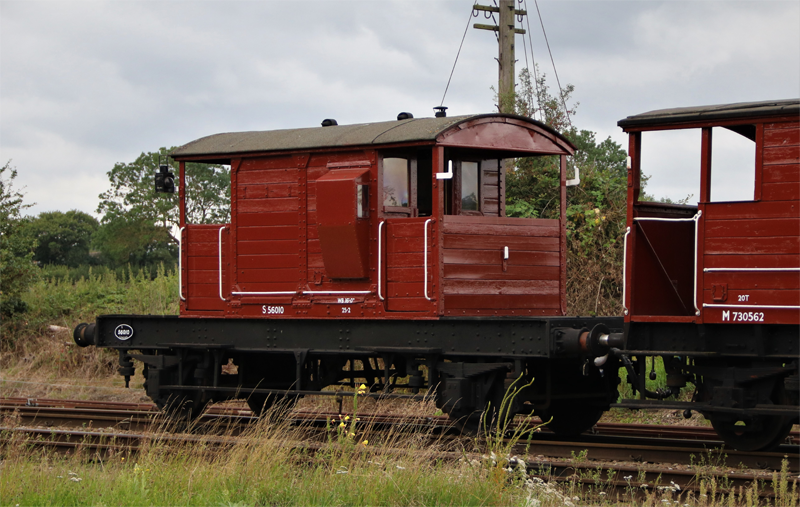
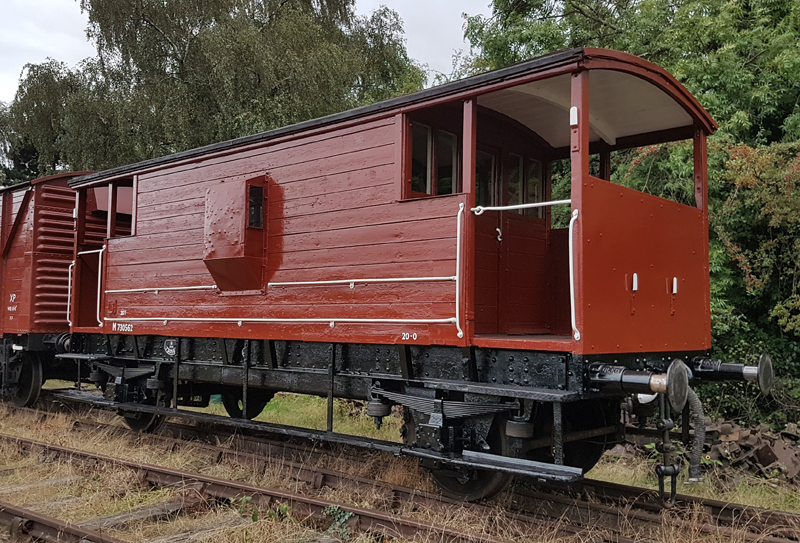
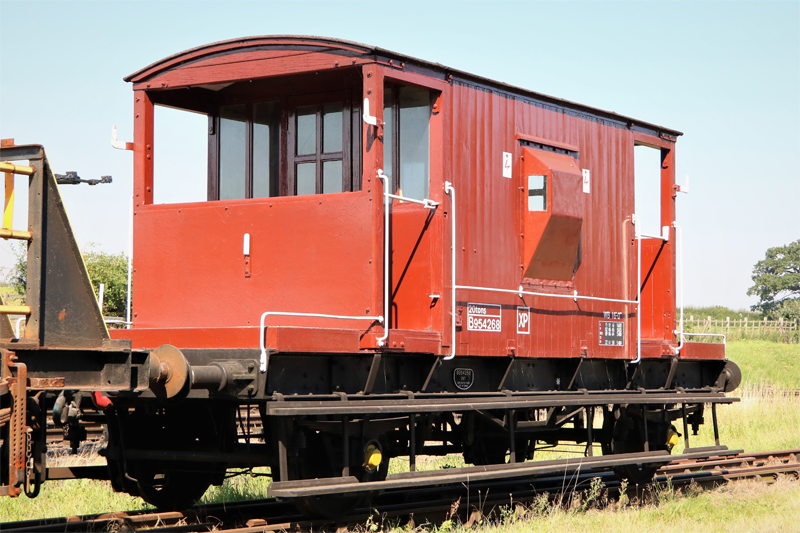
    In the Quorn Wagon & Wagon fleet we are lucky to have four brake vans, all of which have been restored for use at the GCR. In each case, in addition to the replacement of various sections of the bodywork, the restoration by the team has involved corrosion removal, applying rust prevention and wood preservatives, brake equipment overhaul, axle bearing maintenance, full internal refurbishment, stoves, new upholstery and painting, underframe scraping, full external repaint and sign writing.

    Our oldest is S56010 a Southern 25T, 16ft wheelbase ‘Pilbox’ Brake built at the former London Brighton & South Coast Railway works at Lancing in 1930 to Lot No.3033, restored in 2018 including the complete replacement of one veranda and external timberwork, door planks and windows, stove re-built and stovepipe.

    Next in order of age is M730562 an LMS 20T, 16ft wheelbase Brake built in Derby 1938, Lot No.1104, also restored in 2018, including the complete replacement of external timberwork.

    Then we have B954268 a BR 20T, 16ft wheelbase Brake built in Darlington 1958, Lot No.3129, restored 2018 including replacement of a significant amount of external and veranda timberwork, however currently out of traffic due to wheelset damage.

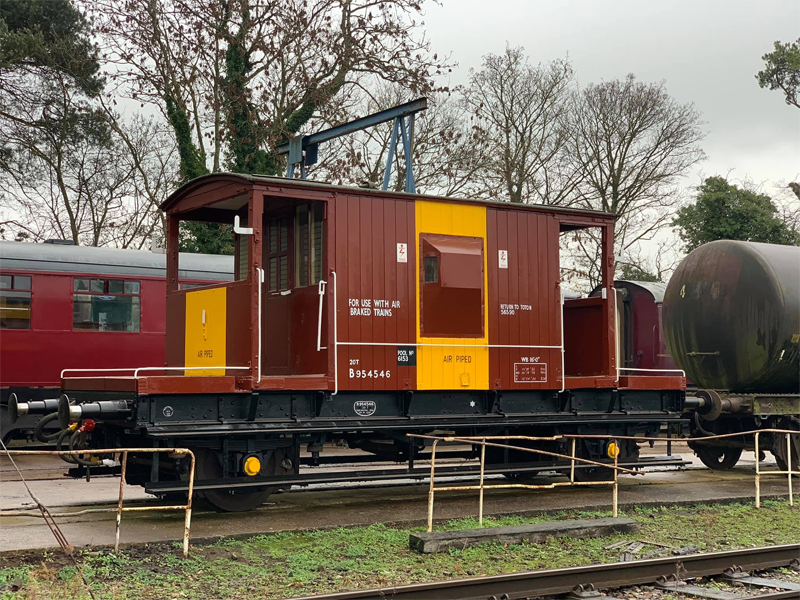
    Finally our youngest B954546 a BR 20T, 16ft wheelbase Brake built in Darlington 1959, Lot No. 3227, restored last year after 8 years out of use, work included timberwork replacement to the verandas although brake rigging work remains

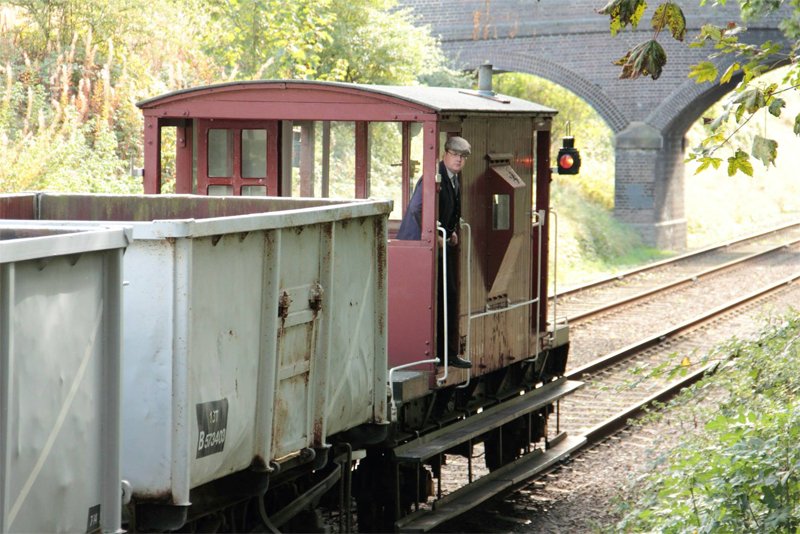
    Operationally at the GCR a brake van is marshalled at each end of goods trains, this is to assist with more timely changes of direction at each end of the line, which ensures that our brake vans are used regularly, but does mean that we have to keep on-top of the operational wear and tear.

    Matt of course, and as some of our images show, did use to operate these vehicles during his tenure with the operations department, his biggest sense of helplessness was the dreaded sound of couplings rapidly tightening as the crew were a little exuberant with the regulator. With up to twenty vehicles and a foot of slack between each, whatever speed the loco has achieved in that 20ft is instantly applied to the brake van as the last coupling tightens, on a number of occasions he recalls bracing himself between duckets or grasping the brake standard as the inevitable approached, but as he confirms it is all part of the fun.

    Next week we shall take a broad look at our departmental vehicles and the work they undertake on the modern day Great Central Railway, not all of our vehicles are used to demonstrate what they once did some still actually do the work they were built for and more.

  • Vehicle Profile #6 – Salmon

    Vehicle Profile #6 – Salmon

    Thank you to Matt for the articles on signwriting. A very useful reference for those of us looking after and modelling heritage rolling stock. For this weeks update, I’ve gone back to the Vehicle in Profile series to look at what is the longest wagon in our fleet – a Salmon.

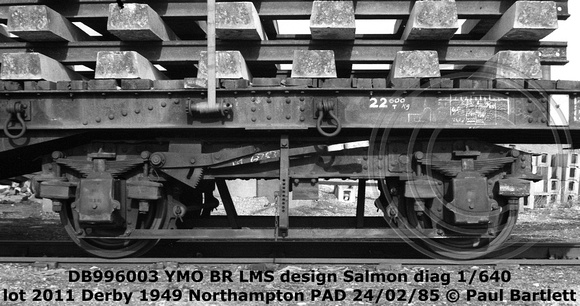
    Built to an LMS design, the Salmon was built between 1949 and 1961 to 15 different lots. In that time many sites and companies built them including Head Wrightson Ltd, G R Turner and British Railways at Derby and Wolverton. The designs started with diagram 1/640, which had LMS style bogies with an independant ratchet handbrake on each bogie (shown in the picture below). There was a wooden floor down the 62ft length of the wagon with 5 bolsters. Early on Salmon were found unfitted or fitted with a vacuum through pipe.


    Paul Bartlett's Photographs: BR LMS design Salmon Diag 1/640 YMO &emdash; DB996003 YMO 03
    Image courtesy of Paul Bartlett’s excellent website.


    Later designs of Salmon had  Plateback bogies with a wheelbase of either 5ft. 6in. or 8ft. These still had oil axleboxes so were limited to 50mph. In the TOPS era these were classed ‘YMO’. In the 1980s some of the fleet of Salmon were overhauled and had air brakes fitted, with extra tie down points added for ratchet straps. These became YMA or YMB depending on whether they retained the vacuum through pipe or not. In the late 90s two wagons were fitted with roller bearing bogies. A further 125 wagons were converted. The conversion didn’t result in a speed increase for the wagon, but bought about reliability improvements. For those remaining in service further conversion work was undertaken in 2009 to add 3 bolsters to the wagons to simplify the loading of track panels. The bolsters would locate the track panel on the wagon laterally and longitudinally. These conversions received another TOPS code, YKA, and another fishkind name; Osprey.

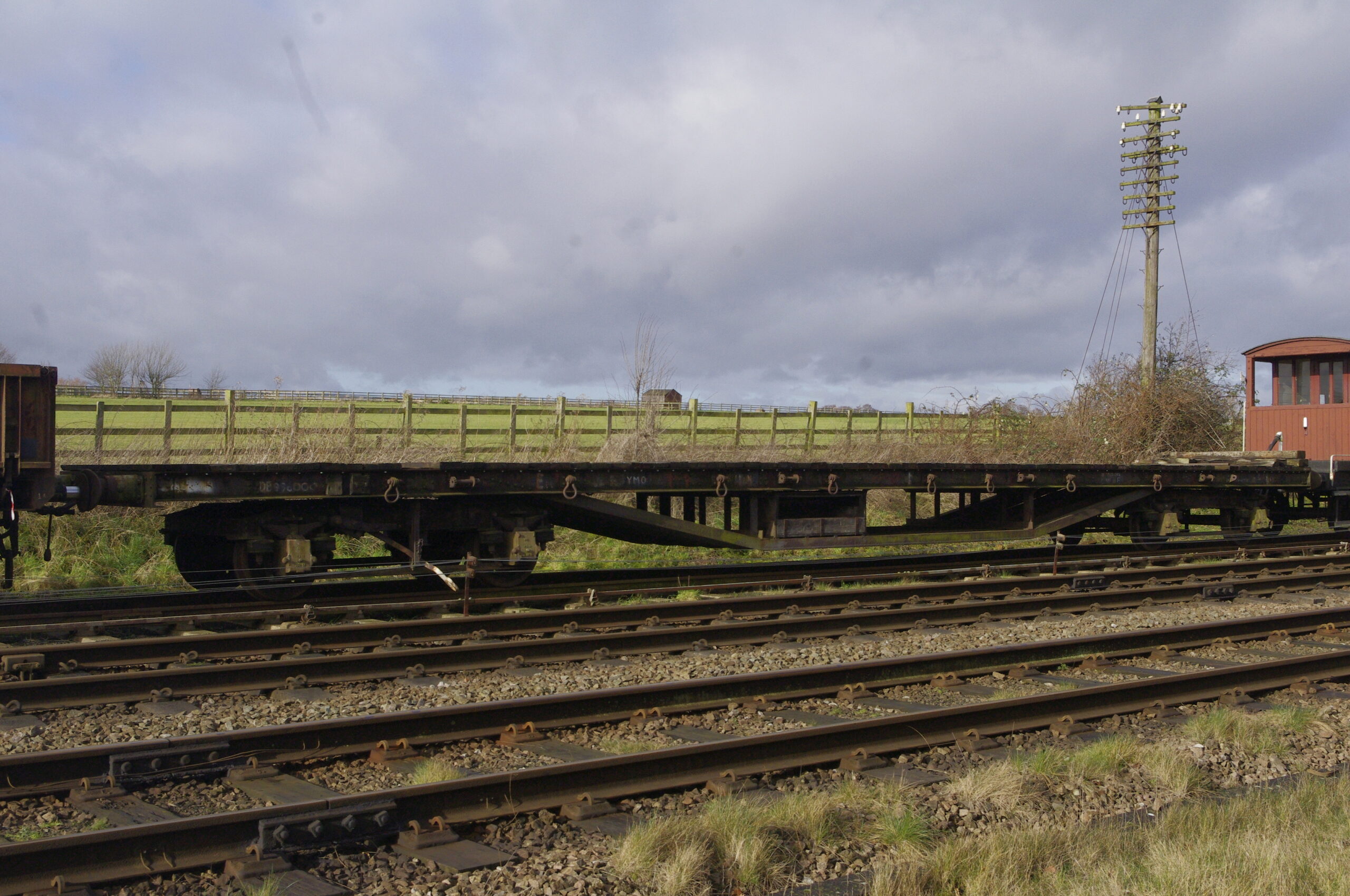
    Our Salmon is the sole survivor of the LMS designed batch. Numbered DB996000 is was the very first Salmon built by BR to the LMS design. It was built at Derby Litchurch Lane works in 1949. Not a lot is known about its service life, but this wagon ended up as an internal user with the number 024717. It served at the very works it was built at as a vehicle to move items around the works. We don’t know exactly when it was confined to the works, but the earliest sighting on departmentals.com puts it at Litchurch Lane in 1985. It served in this role until 2014, where it was donated to us by Bombardier Transportation.  Soon after it had arrived various accoutrements were ground off and a floor added using used sleepers cut in half down the length. With a pad exam and oil up of the brake gear it was released to traffic and has remained available ever since.

    Thank you for reading! We hope everyone is keeping safe and healthy at this time.
     

  • Vehicle Profile #5 – Rudd

    Vehicle Profile #5 – Rudd

    Last week, we published a profile of the Grampus wagon, a versatile 20 ton capacity engineering wagon. Our next Vehicle Profile covers their one of their replacements; the Rudd.

    With design of the Grampus and other engineering wagons becoming unsuitable for the change in working methods, replacement wagons were converted from stored HTV coal wagons to varying designs. These use the Fishkind names of the Tope, Clam and Rudd. Of note to us are the Rudd design, of which we have 3 examples.

    • DB972018, converted at Marcroft in 1990 to design ZB001A. In its past life it was HTV B429632 built at Gloucester Railway Carriage and Wagon in 1958.
    • DB972608, converted at CC Crump in 1991 to design ZB001A. Its HTV number was B429763 built by Hurst Nelson in 1957
    • DB972681, converted at CC Crump in 1991 to design ZB001A. It was HTV B424802 built in 1957

    The Rudd name initially appeared in 1987 on converted Grampus of which one (DB984194) is preserved at the Nene Valley. These conversion retained the Grampus’s single skinned slab doors but had rebuilt with non-removable ends and air brakes.

    The Rudd named was later reused on a design had the same three doors per side, fixed ends and air brakes as the Grampus based conversion, but had stiffer ends and a different design of door which made them less susceptible to damage by mechanical loading equipment. The doors on the Grampus are heavy and require 2 or more people to lower and raise them. The Rudd doors, while arguably heavier, can be opened and raised by one person; benefitting from the use of door control equipment. Using the door control equipment also meant the ‘bangers’ fitted to the underframe wouldn’t require fitting removing a potential for trapping hands.

    Of the 3 designs intended to replace the likes of the Grampus, and other similar engineering wagons, the Rudd lasted the longest primarily due to their air brakes, while the Tope and Clam retained Vacuum. By 2005, an estimated 2 Tope remained in traffic, with 3 Clam. By contrast, 278 Rudds remained in traffic until 2008.

    Back to our Rudds, like our Grampus they remain fit for use and their turn in the restoration queue remains behind the wooden bodied vehicles in the mixed freight.

  • Vehicle Profile #4 – Grampus

    Vehicle Profile #4 – Grampus

    _IGP6846.JPG

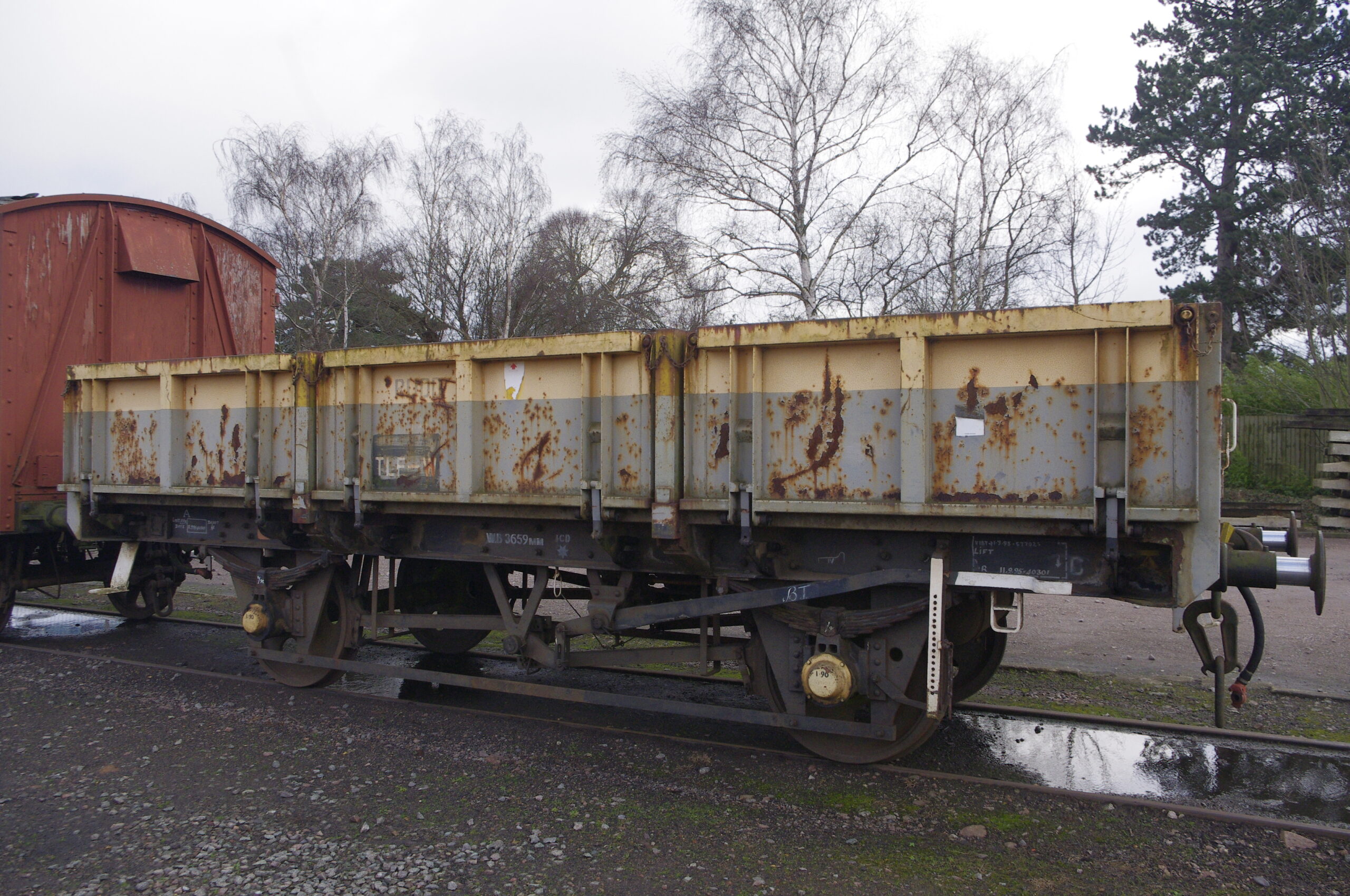
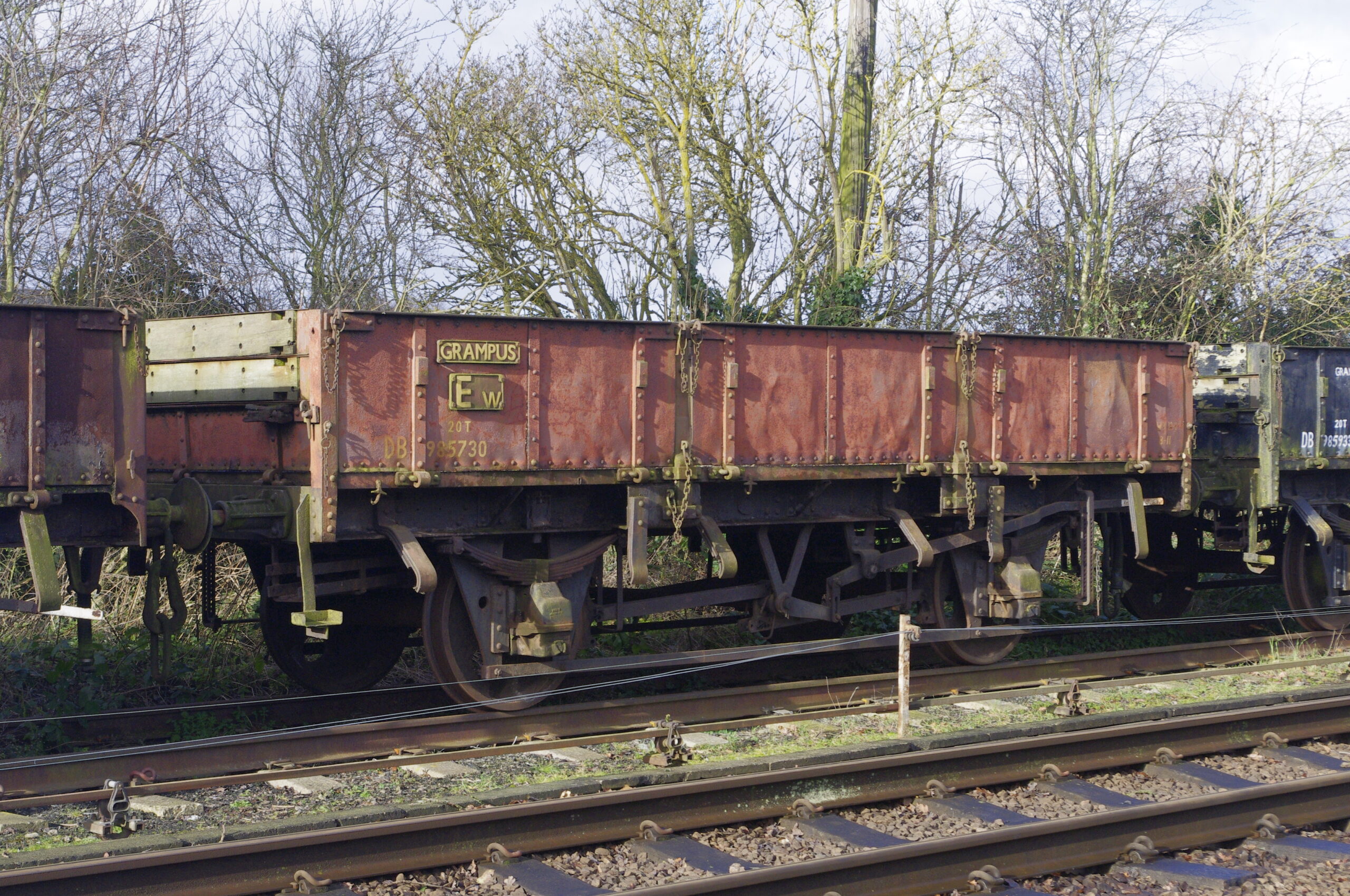
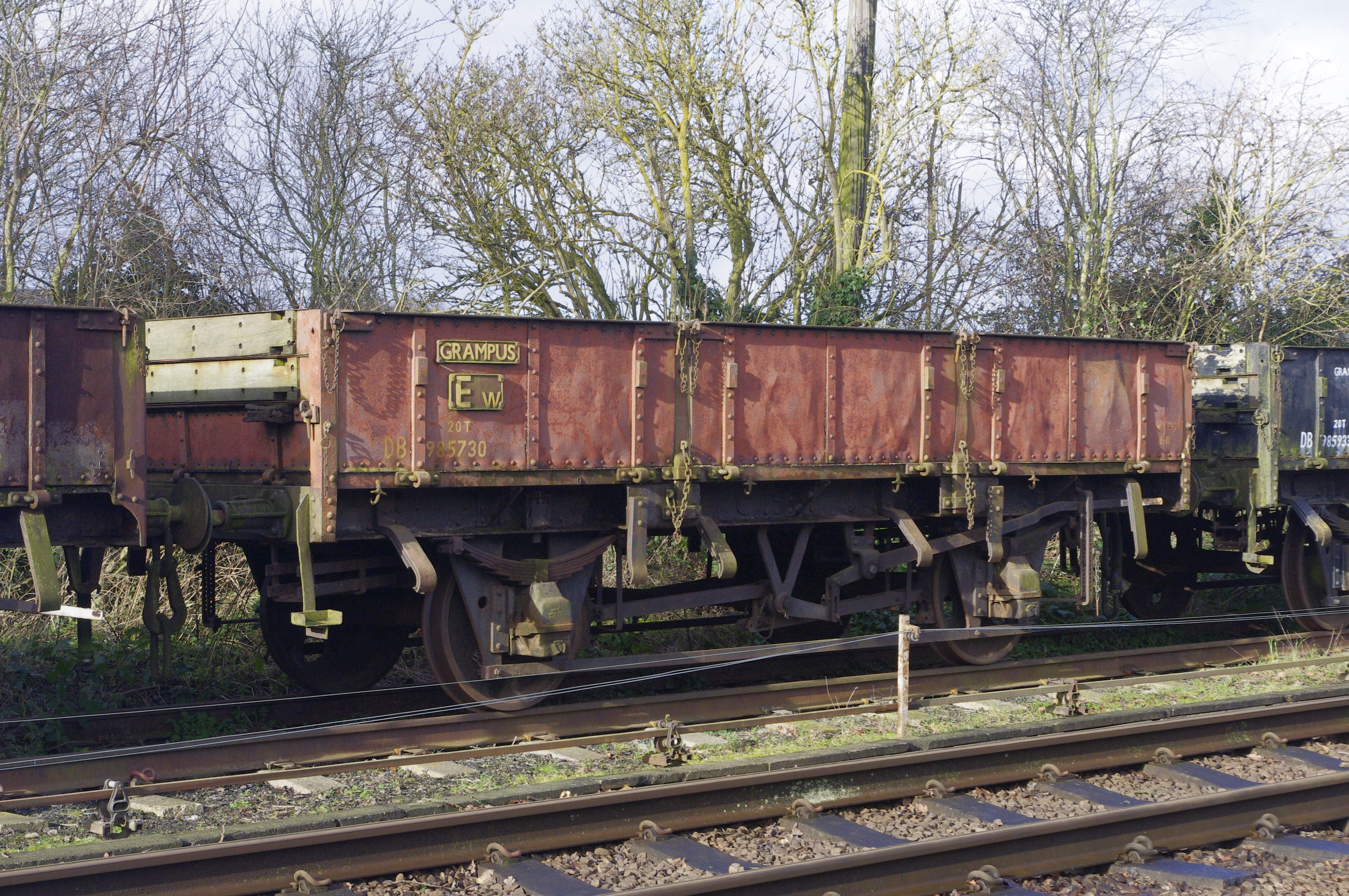
    Grampus are 20 ton multi-purpose engineering wagons, designed by British Railways and built between 1951 and 1961. The design is based heavily on the earlier GWR all steel Tunny (which we also have one of) and Starfish, with ends similar to the Southern region Lamprey. Grampus had a 20 ton capacity and as such had 10″x5″ axle boxes. Our fleet show a variety of variants of these. Most of these wagons were built unfitted, though few were vacuum braked. Our fleet, naturally follows this model, with six being unfitted, and one being vacuum fitted. Details of our fleet are below.

    NumberYear BuiltAllocated RegionAllocated Region
    DB9846421957Eastern RegionChesterton Junction Central Permanent Way Depot
    DB9847131957Western RegionCO
    DB9857301954North Eastern RegionDarlington Reclamation Depot
    DB9858841953Scottish RegionGreenhill Creosoting Depot
    DB9859331954Midland RegionLiverpool
    DB9905851952Midland RegionNorth Wales
    DB9914081959Eastern RegionDistrict Engineer Ipswich

    Grampus are built with three drop down doors and two removable cast iron stanchions per side. Across the end of the wagon there are two removable planks on the end, which can be stowed in pockets under the end of the wagon. The end of the wagon also has a drop down door to allow wheeled vehicles to roll from one wagon to another. These make the wagon very versatile, able to be loaded and unloaded by hand and able to take loads over the length of the wagon.

    Being a truly versatile wagon, they could carry sleepers, ballast and chippings. In the era of the steam loco, it carried loco ash away from depots for re-use elsewhere. However in more modern times, with mechanised loading machinery, the wagon’s single skin steel doors, wooden floors and removable end planks made them susceptible to damage. The later Rudd and Clam wagons suffered with this less as they had much stronger doors (though Clams had no doors), solid ends and steel floors.

    All but one of our fleet have had steel floors fitted in place of wood, and where doors have been damaged, particularly at the top, we have tried to straighten them as best we can. Doing this means the doors shut correctly and can be retained by the pins. Ours stand ready to be used, receiving regular maintenance awaiting their turn in the paint queue. As they are all steel, they do stand the weather better than any of the wooden bodied wagons we have in the fleet which take the priority in the queue. Join us next time for a profile of their successor, the Rudd.

  • Vehicle Profile #3 – The Yellow Coach

    Vehicle Profile #3 – The Yellow Coach

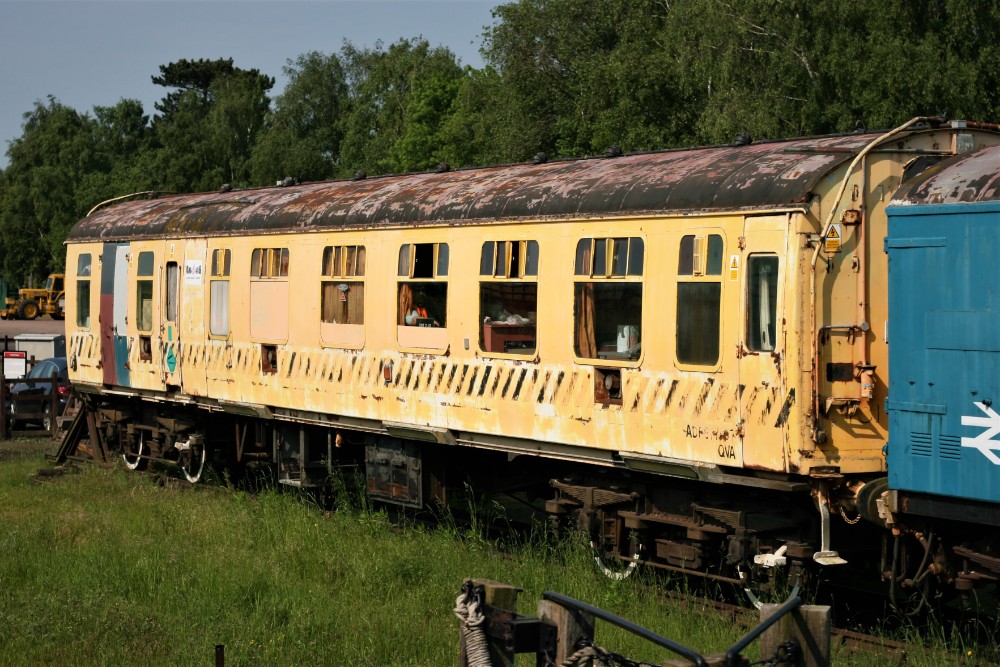
    Up next in Vehicle Profile Series we have coach very important to us, and is very much missed. The coach formed the base of our operations since 2011, and has all the usual mess facilities needed for us to work on the wagons of the fleet.

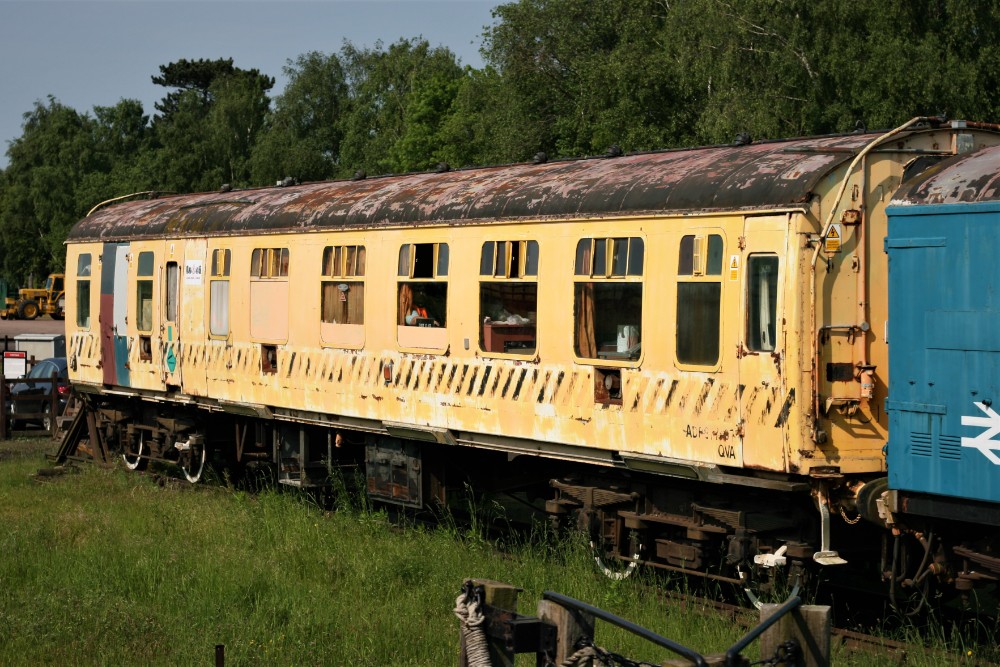
    The Yellow Coach – ADB977107 (Sc21202, E21202)

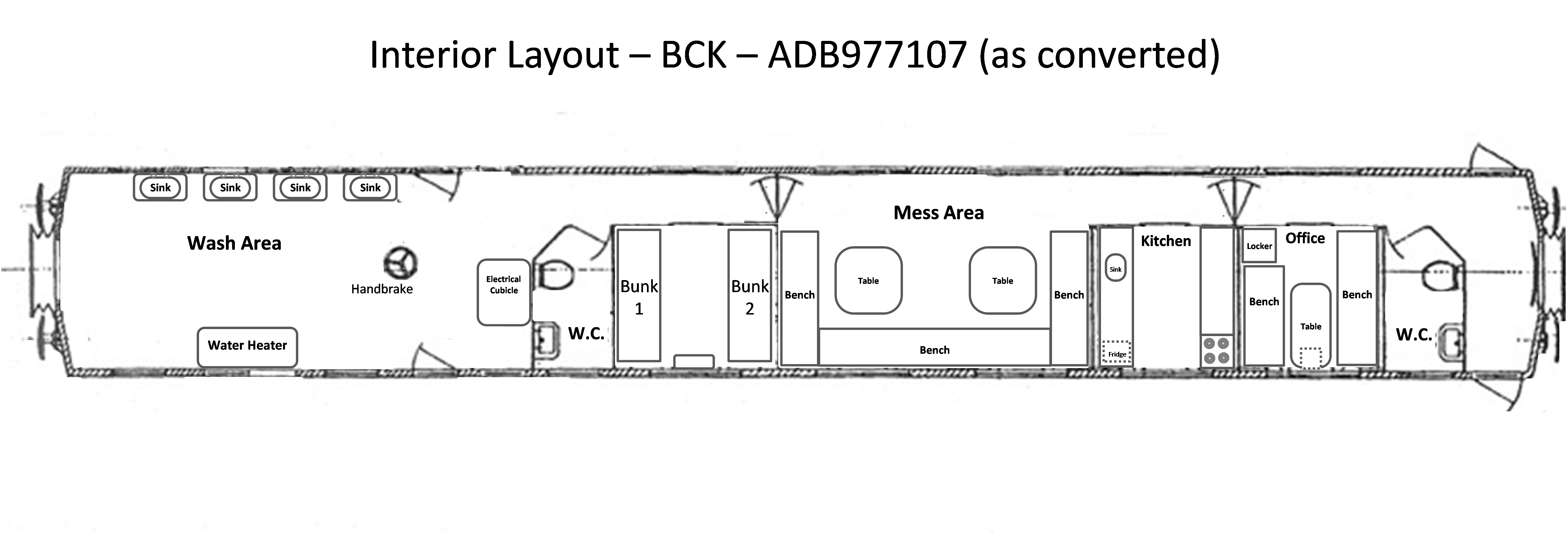
    The vehicle we refer to as the ‘Yellow Coach’ was built in 1958 at Metro Cammell in Washwood Heath, Birmingham as 21202, a Mk 1 Brake Composite Corridor [BCK] coach to diagram number 171, as part of lot number 30425. It was converted for use at a Breakdown Train Unit (BTU) staff coach in 1983 at Slade Green being fitted with BR Mark 3A ex.EMU trailer bogies. The modifications undertaken as part of its BTU role included:-

    • additional heating
    • additional lighting
    • kitchen area
    • sleeping compartment with four bunks
    • mess area with large tables
    • office compartment
    • water heater
    • washing area

    Re-classified as QVA and renumbered ADB977107 it was then transferred to Eastleigh where it was used in the breakdown train until the mid 1990s. The coach continued in breakdown train use moving to Crewe. Finally after moving to Wigan the coach had fallen out of use by 2010 and was stored at the Wigan Disposal. From there it was bought on the 23 July 2010 by Nick Tinsley, and subsequently moved to the GCR. It resided in the sidings at Quorn for many years, providing a base for the Quorn Wagon & Wagon group. In 2019 with the condition of the body deteriorating, and requests from the railway to tidy up the yard, the coach moved to Rothley where it is receiving much needed body repairs, electrical system modifications and interior restoration.

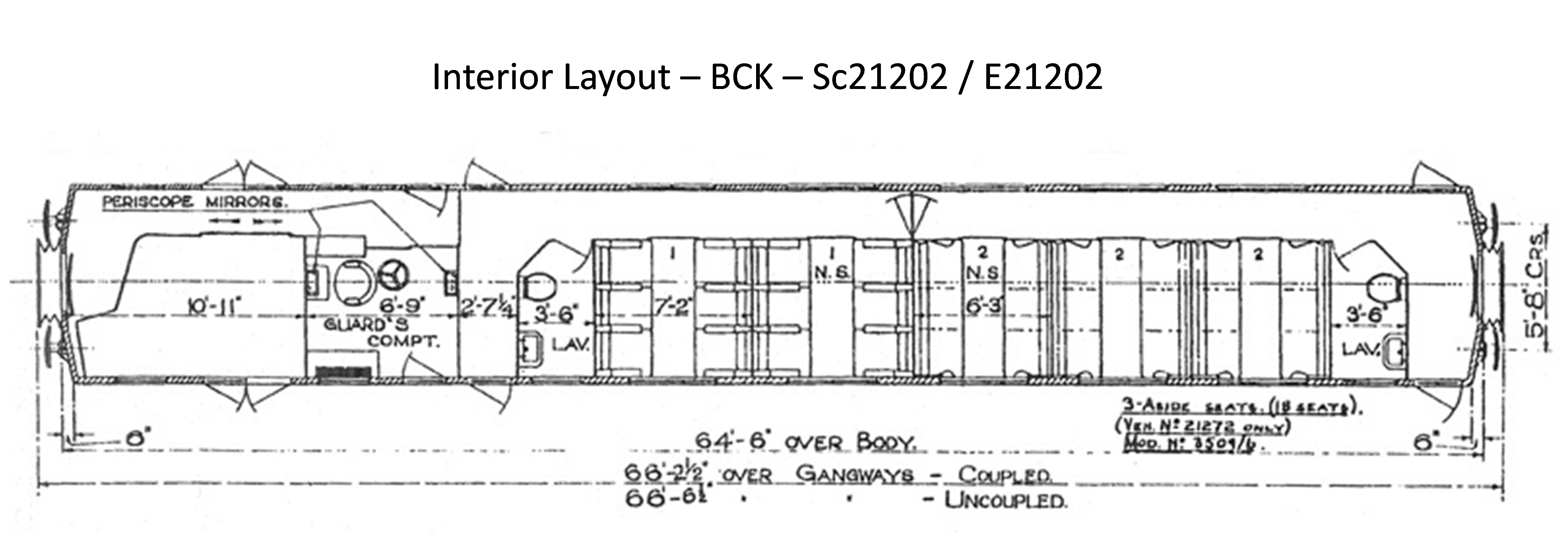
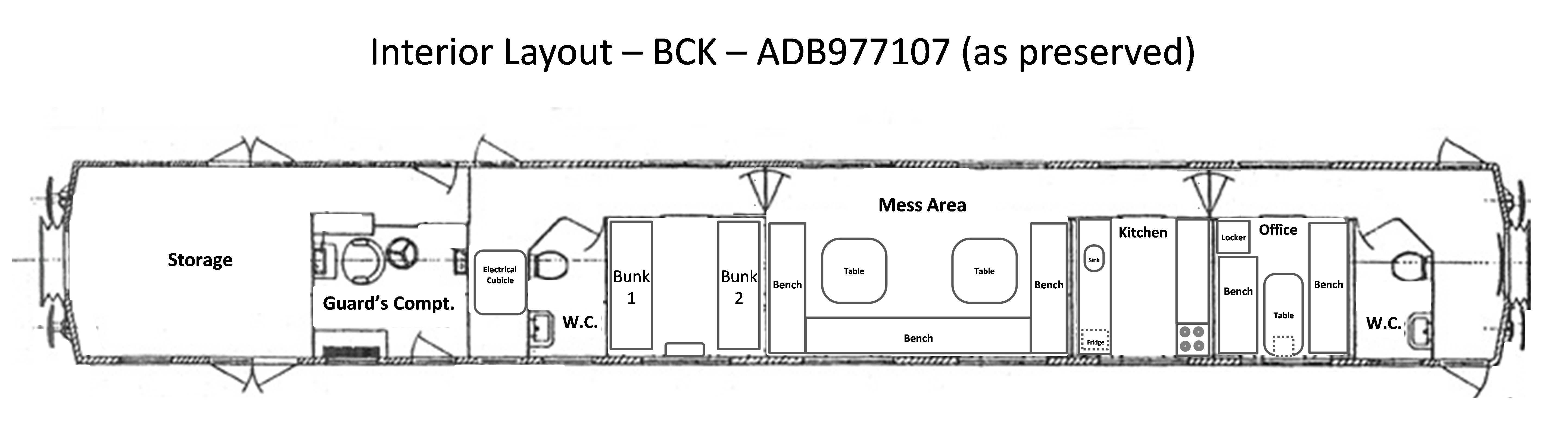
    Below are some diagrams of the layout of the coach, in service as a BCK, when converted to breakdown train use and now, in preservation.

    BCK - Sc21202 Layout Diagram

    BCK - ADB977107 Layout Diagram As Converted

    BCK - ADB977107 Layout Diagram As Preserved

  • Vehicle Profile #2 – Test Car 2

    Vehicle Profile #2 – Test Car 2

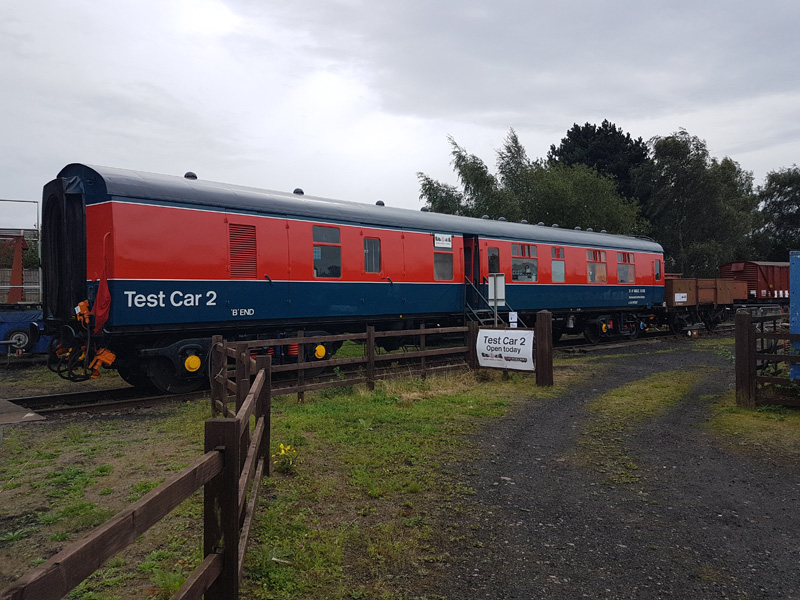
    Carrying on with our Vehicle Profile series, we have a vehicle you have already seen plenty about. Test Car 2 is currently in use as our mess facility while ADB977107 is receiving bodywork attention. We have previously opened the Test Car at Galas, something which we plan on doing again, though it currently remains to be seen when that will be. Thanks to Dave for pulling the summary together for Test Car 2.

    TEST CAR 2 – ADB975397
    This special coach was built in 1962 at Wolverton Works as 35386, a Mk 1 Brake Second Corridor [BSK] coach using Commonwealth bogies as part of lot number 30699. It was transferred to the Department of Mechanical & Electrical Engineers [DM&EE] at Derby in 1974 and renumbered ADB975397.

    For the next 35 years Test Car 2 was used primarily for slip/brake testing, which was the preferred method of assessing the brake stopping distance performance of new or modified rolling stock. This test method allowed the brake stopping distance of a vehicle to be measured independently and not influenced by other vehicles coupled in a train.

    The layout of the interior of the coach was adapted specifically for this role including the installation of:-

    • a Perkins 3-cylinder 20-kVA diesel generator,
    • 240v electrical installation, a distribution panel and shore supply,
    • test instrument racks,
    • large table top area,
    • on-board instrumentation systems,
    • slip-coupling,
    • oleo buffers,
    • specially modified air and vacuum brake system,
    • large drop-down gangway door window,
    • inward opening access doors,
    • test gauges,
    • heating,
    • lighting,
    • an underframe mounted 90-gallon fuel tank,
    • 10 bar air compressor with 150-litre air reservoir,
    • workshop area,
    • battery chargers,
    • secure storage for the instrumentation cables,
    • a kitchen with cooking facilities,
    • re-sited the toilet compartment,
    • additional body-end windows.

    During its working life as a test car, ADB975397 is estimated to have been used in excess of 450 occasions for slip/brake testing. It remained at the Derby based Railway Technical Centre until its withdrawal in 2008; Test Car 2 was then moved to the Old Dalby Test Track in 2011 and stored by Serco until it was secured for preservation in 2016 by Matt Baker, and moved to the Great Central Railway. The decision was made by the Quorn Wagon & Wagon Group in 2018 that the unique Test Car 2 would be retained as a test car in preservation, unlike so many similarly preserved test coaches that have been re-converted for passenger use. The restoration work has been undertaken by the Quorn Wagon & Wagon Group at the Quorn & Woodhouse station yard. The interior layout retains the ambience of 1990s testing life whilst display boards provide visitors with an insight into the history of this Test Car, including details of how and why slip/brake testing was carried out.

  • Vehicle Profile #1 – Air Braked Steel High

    Vehicle Profile #1 – Air Braked Steel High

    While we aren’t able to get on site to take part in any work to give you any updates, I’d like to continue with some different content to keep people interested and give people something to interact with while we are socially distancing. These might take the form of a profile of a vehicle in the collection, describing its history; or sharing some British Transport Films that are favourites of the team. Please let us know if there is anything you’d like us to explore.
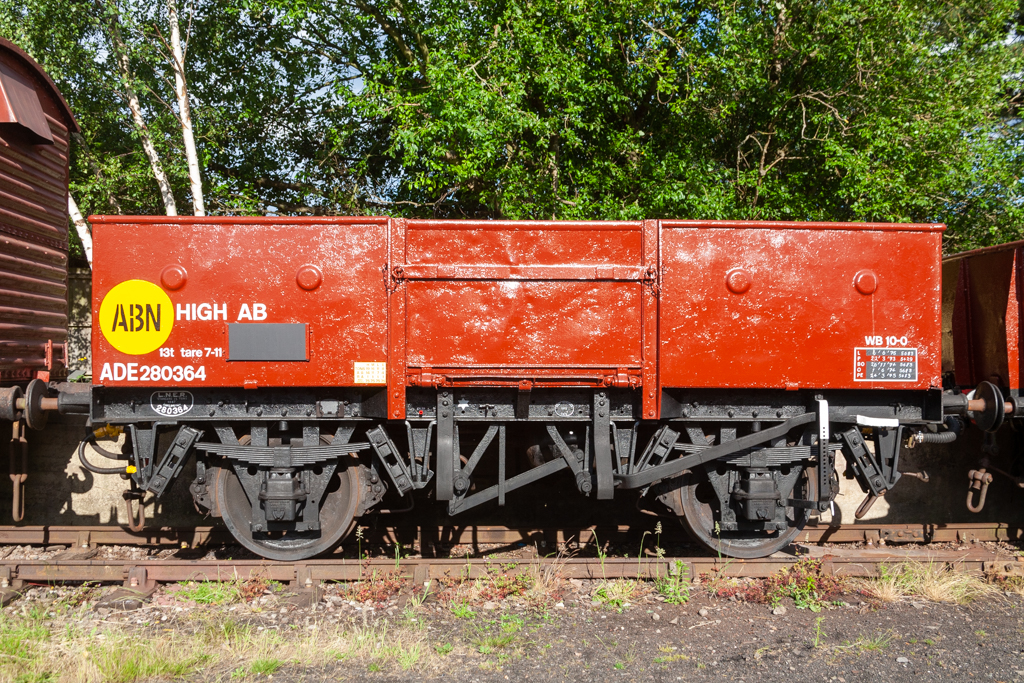
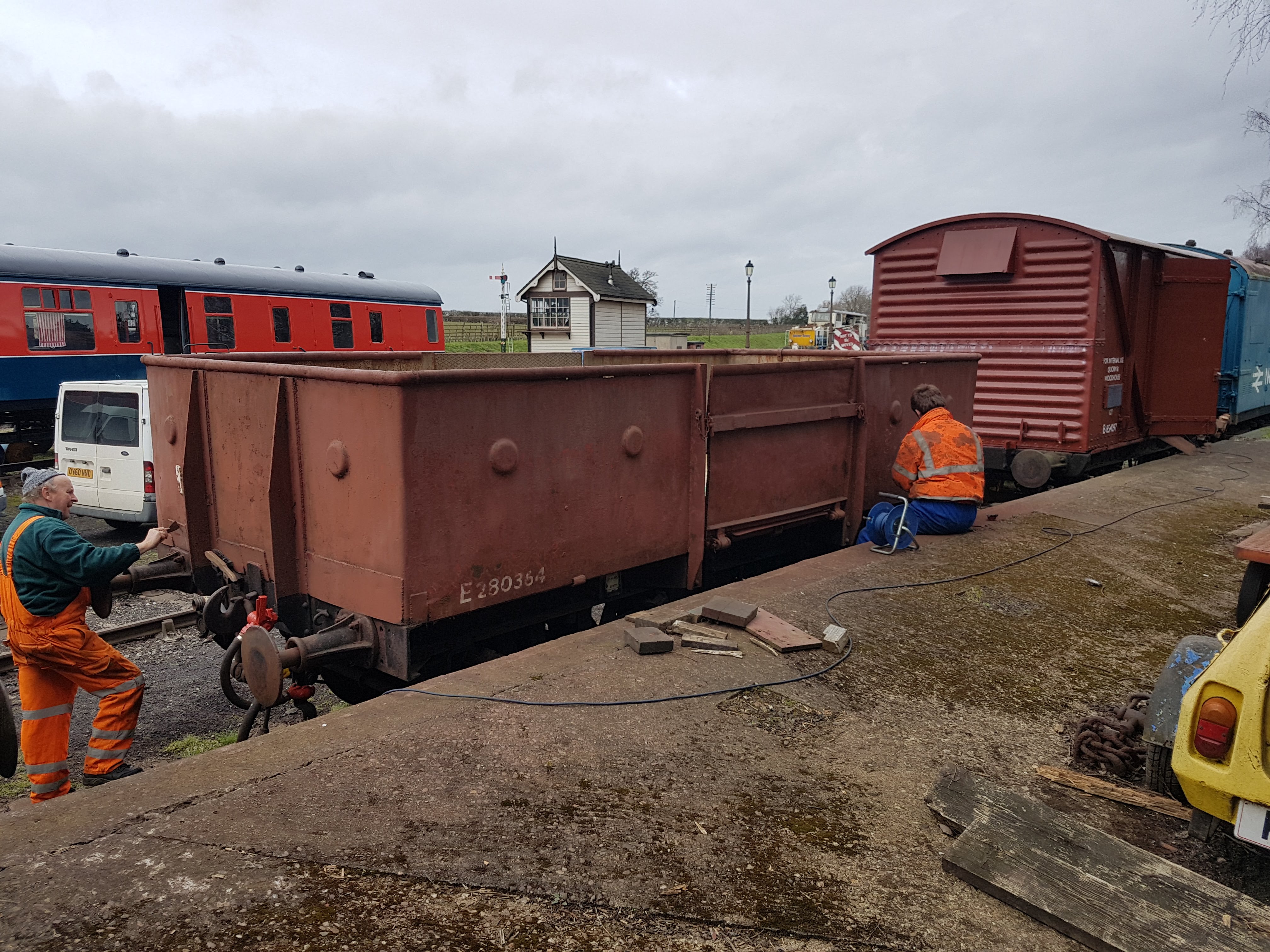
    Tonight, I’ll start with E280364, our Air Braked LNER Steel High.
    All-Steel Highfit wagon E280364
    Type OHB
    Diagram No. 194
    Capacity 13 Tons
    Wheelbase 10ft
    Built 1947 in Darlington
    During 1970 a total of 40 wagons of five types were modified by BR Western Region, for a trial of air-braked wagon operations with increased operating speeds between Oxford and Worcester.
    The modifications that allowed the maximum operating speed to be increased from 45 to 60 mile/h included:-
    Uprating the suspension leaf springs from 5-plate to 9-plate,
    Converting from shoe type to BR long suspension links,
    Installation of two-pipe auto-air brake equipment.
    The wagons that were modified for the trial comprised:-
    Twelve, 13T All-Steel Highfits (OHB)
    Twelve, 12T Vanfits (VVB)
    Seven, 12T Palvanfits (VPB)
    Four, 22T TubeVB (STB)
    Five, PlateVB (SPB)
    The trials ran until 1972, following which all 40 wagons continued in service as part of the then growing fleet of air-brakes wagons.
    The All-Steel Highfit wagons of which E280364 was one, continued in network service until the late 1970s. They were then transferred into departmental use for carrying spare parts between depots, the last being withdrawn in 1992.
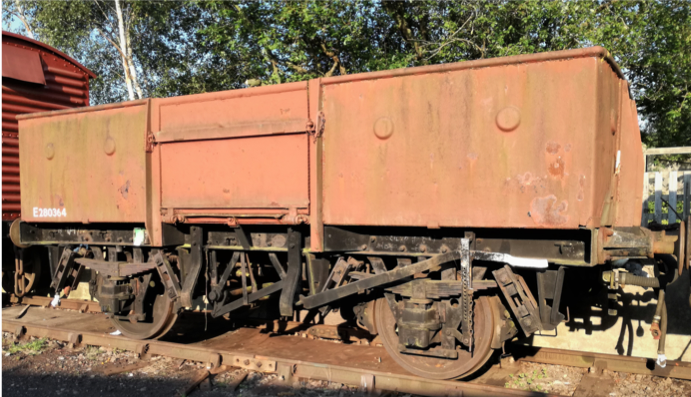
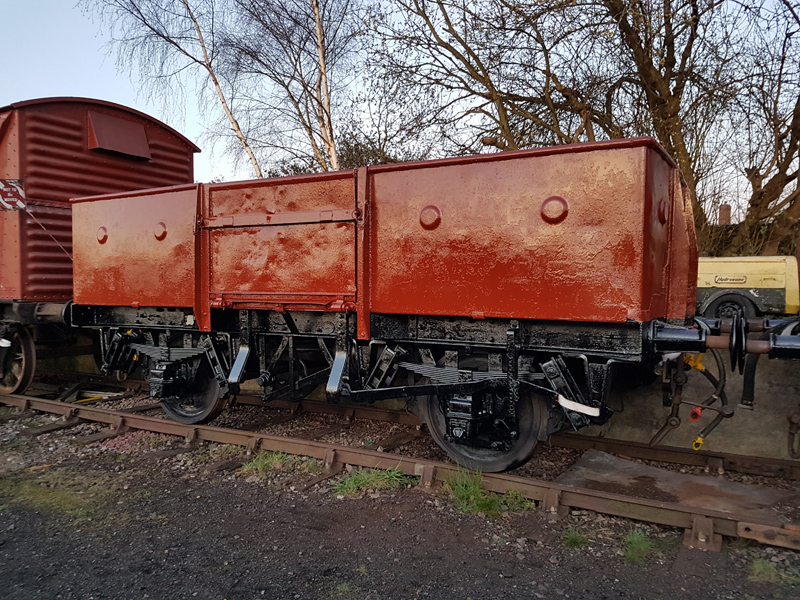
    E280364 which was built in Darlington in 1947, was rescued for preservation by Nick Tinsley in late October 1990 from Peterborough Wagon Shops, and is currently undergoing restoration by us. When we left site E280364 was sat in its bauxite gloss top coat, with the underframe having been sprayed. It awaits signwriting before this vehicle can be released to traffic.
    E280364
    20200322_182043
    20200321_125332
    20200307_124224