
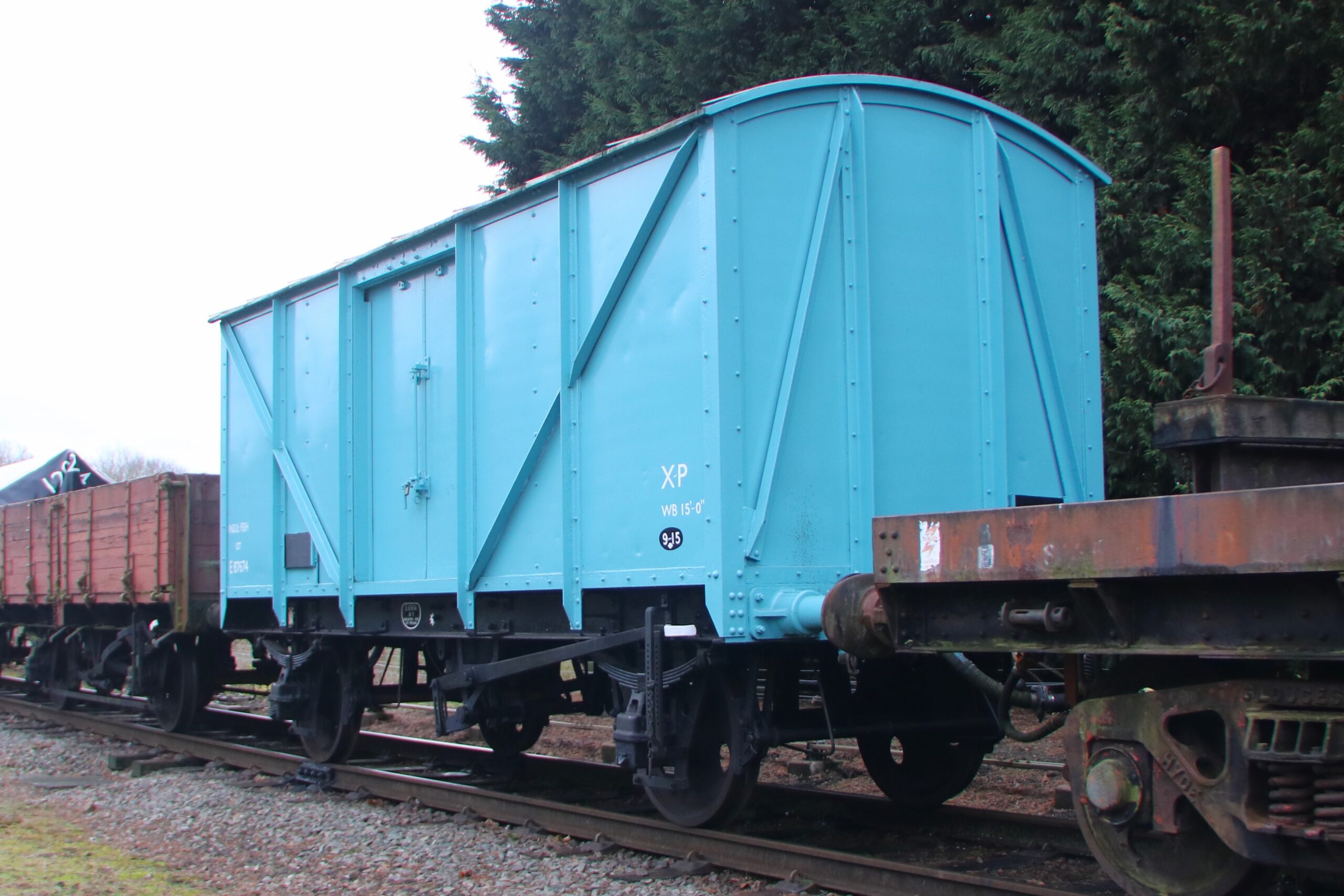
The British tradition of Fish & Chips began in 1860s, there were over 25,000 fish and chip shops by 1910 increasing to 35,000 at their peak in the 1930s. To meet the demand for fresh fish around the country the railway stepped in with fast fish expresses moving between ports and markets usually hundreds of miles apart. To keep them fresh fish were packed in boxes with ice and conveyed in insulated vans.
The British Railway’s Insulated Fish Van (INSUL-FISH) was based on a LNER pre-nationalisation design; a total of 1,058 BR fish vans were built at the Faverdale Works in Darlington, County Durham. 500 to diagram number 800, and 558 to diagram number 801. There were minor differences between each of the builds, however they were all XP-rated with vacuum brakes and a through steam-heat pipe (allowing them to travel in passenger trains).

A dedicated pool of 200 INSUL-FISH vans were specially maintained for the long distance traffic flow between King’s Cross Goods and Aberdeen. however, in order to reduce the risk of hot-boxes a programme was initiated in 1957 to replace the plain journal axleboxes with Timken roller bearing axle-boxes. A total of 375 vans were eventually converted at Cowlairs, York, and Doncaster. The revised arrangement with roller bearing axles allowed speeds of up to 75mph; these vehicles were identified by the application of a large blue spot on the bodyside, which gave rise to the ‘blue spot’ nickname.

The vans were originally painted white to reflect heat from the vehicle; however this colour did not weather well and due to complaints by the merchants selling fish that the public perceived these vehicles as filthy on the outside as well as inside. BR began using a different colour in 1963. This was known as Ice Blue.


When the wet fish traffic by rail effectively ceased in 1968 the ‘blue spot’ vans were adopted for other use including parcels traffic being designated Special Parcels Vehicle (SPV). Many were painted in BR Blue and carrying the Express Parcels branding. Many also received the NRV designation under TOPS. Others were used as engineering vehicles and also barrier wagons. The last BR INSUL-FISH van in revenue service was reported to be in the Aylesbury area in 1981 whilst a number were retained and renumbered after this date as ‘internal user’ vans, such as E87706/ADW87706 which was also renumbered as an internal user 041475 for CCE use; captured by Dave Bower in 1981 at Shirebrook.

At least 18 of these INSUL-FISH vans are in preservation, mostly those which had found their way into the internal user network, including 87706 which now resides at the Keighley & Worth Valley Railway, photo Dave Bower.

A number of the INSUL-FISH van bodies also remain, grounded; including ours (87732) at Quorn.

Our operational INSUL-FISH van E87674 was bought by Nick Tinsley in April 2000 from Crewe Pad Sidings, having been previously been used as a Departmental CCE Tool Van. The photo below is courtesy of Shawn Collier who captured 87674 at Beal St Siding, Leicester in 1988.

We restored E87674 in 2018 into it’s mid 1960s Ice Blue livery, however although this vehicle would have carried a ‘Blue Spot’ being one of those converted to roller bearings; we haven’t applied this because unfortunately plain bearings were re-fitted when it was transferred to departmental use.


E87674 is sometimes included in the van train at the GCR, however being the odd-man-out in it’s Ice-Blue livery, it is more often is seen in the Mixed Goods rake.


Leave a Reply