Author: Dave Bower

  • 12/04/26 – Springs & Noggins

    12/04/26 – Springs & Noggins

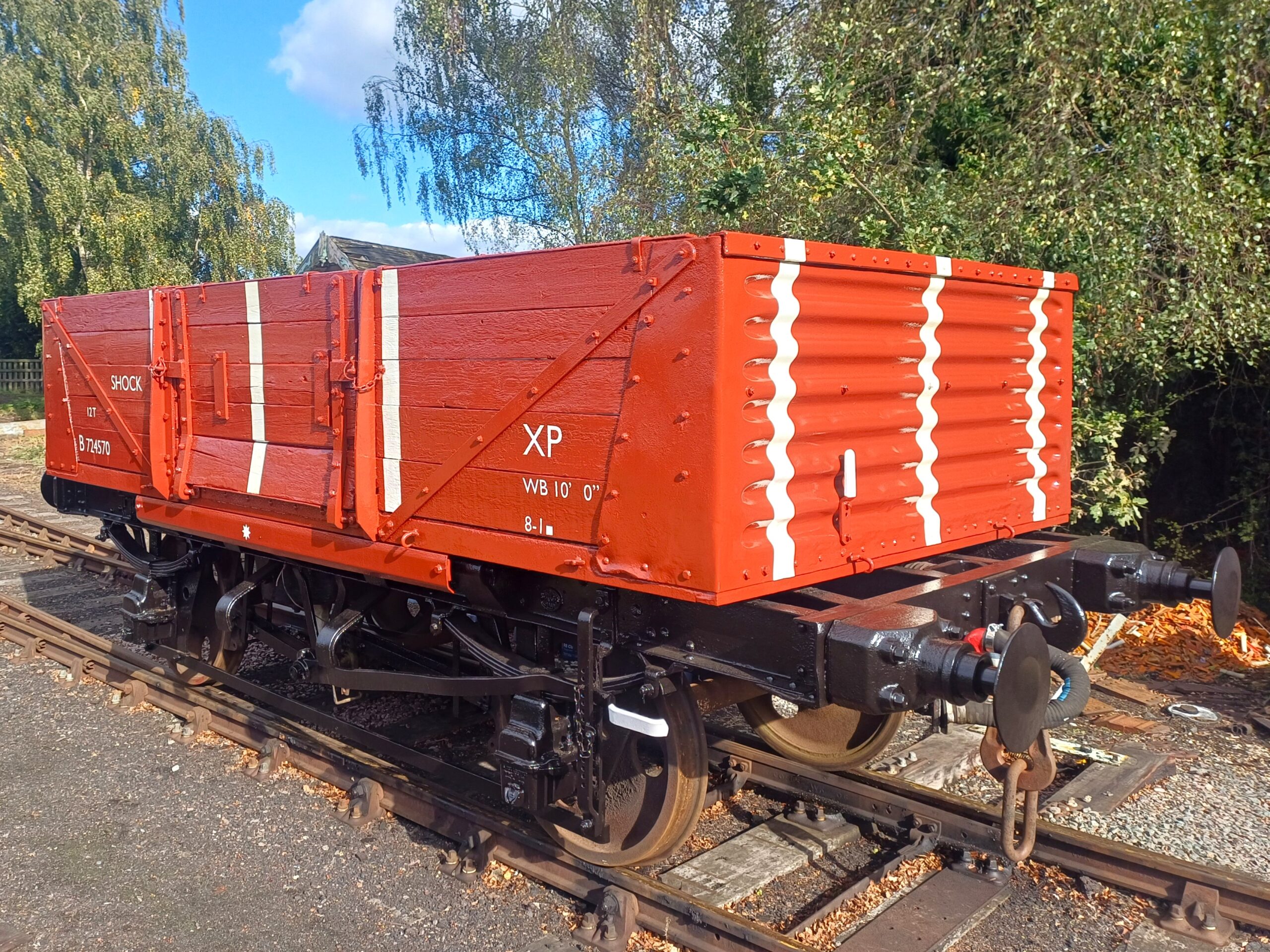
    Hello and welcome to a bumper update from the team at Quorn. Over the last four weeks we’ve been busy re-springing two wagons, making floor hold-down noggins for the Lowfit, giving the Lowmac some TLC, and continuing with Esso tank wagon restoration work.

    Six new wagon springs were delivered to Rothley; four destined for the Palshoc van B855568; the remaining two were taken to Quorn for fitting to Esso Tank 3621.

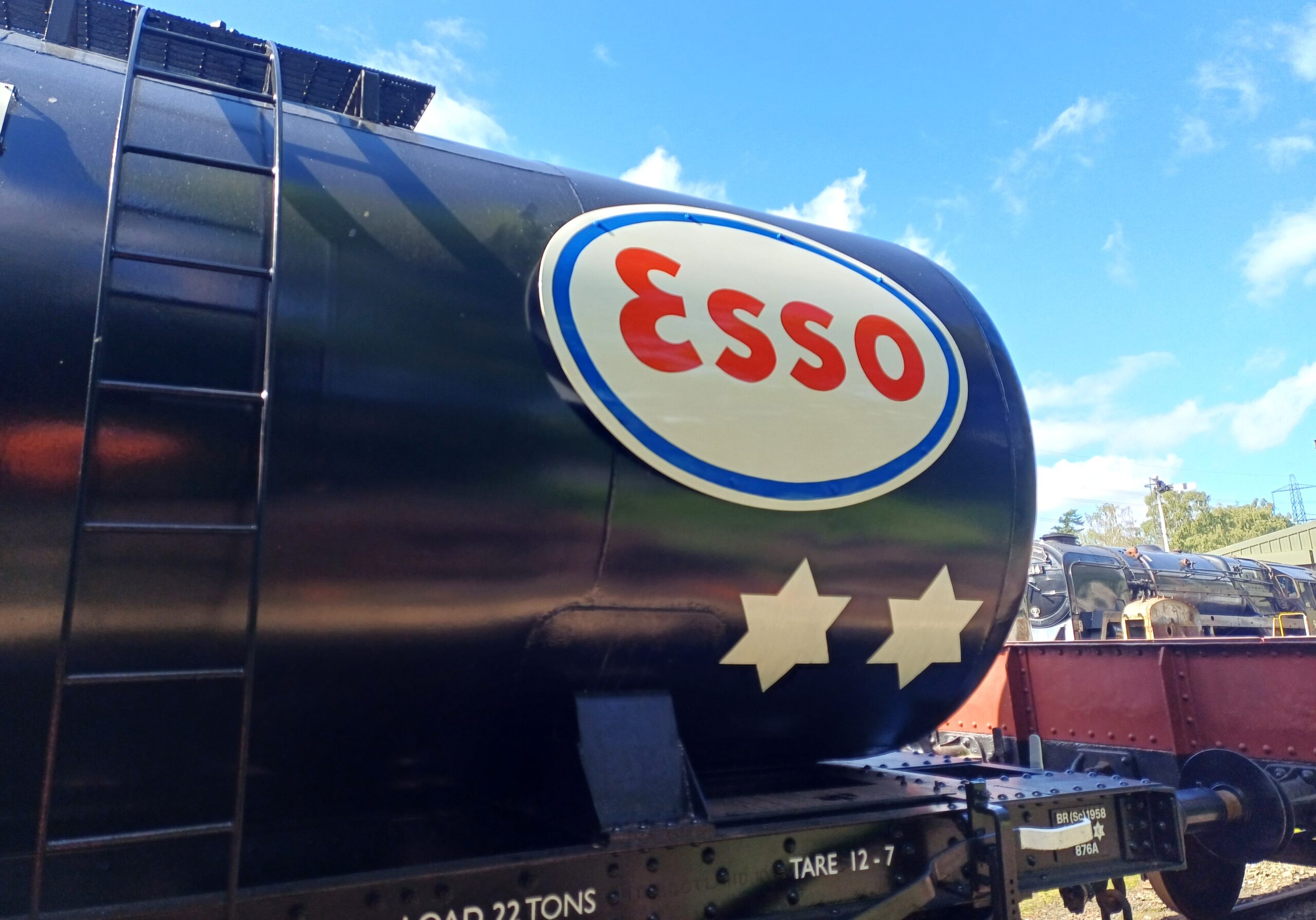
    Ernie, Charlie and Nick fitted 3621s springs, and with this wagon’s restoration now complete, it was tripped to Swithland for marshalling into the tank train ready for the Goods Friday event.

    At Rothley Nick, Charlie and Oliver dealt with the four springs in-turn on Palshoc B855568. The wagon was then moved to settle the new springs and the buffer heights were checked.

    Nick, Mark, Ernie, Dan and Oliver applied some paint to the underframe, swan necks, lamp irons and handbrake levers on the Lowfit.

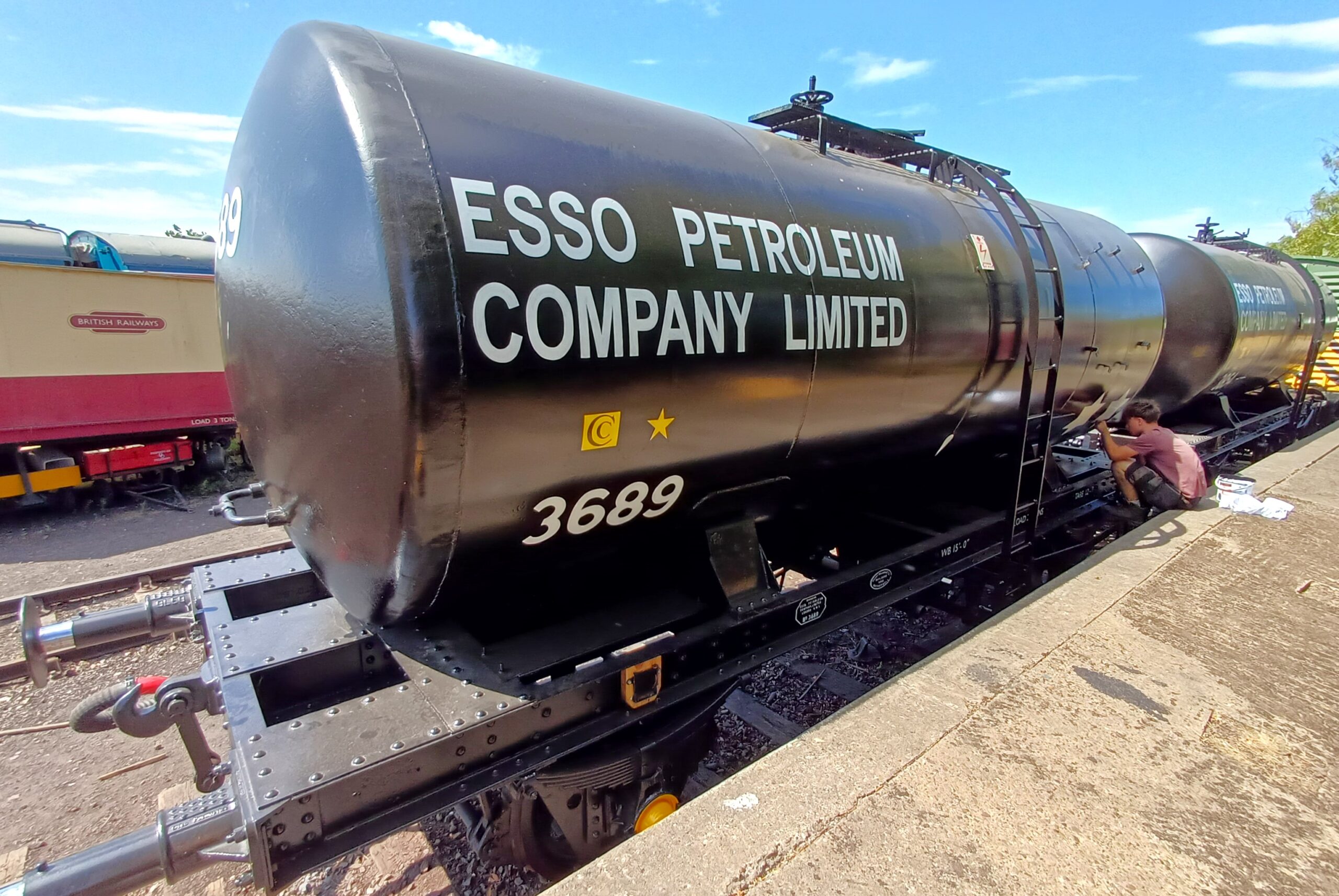
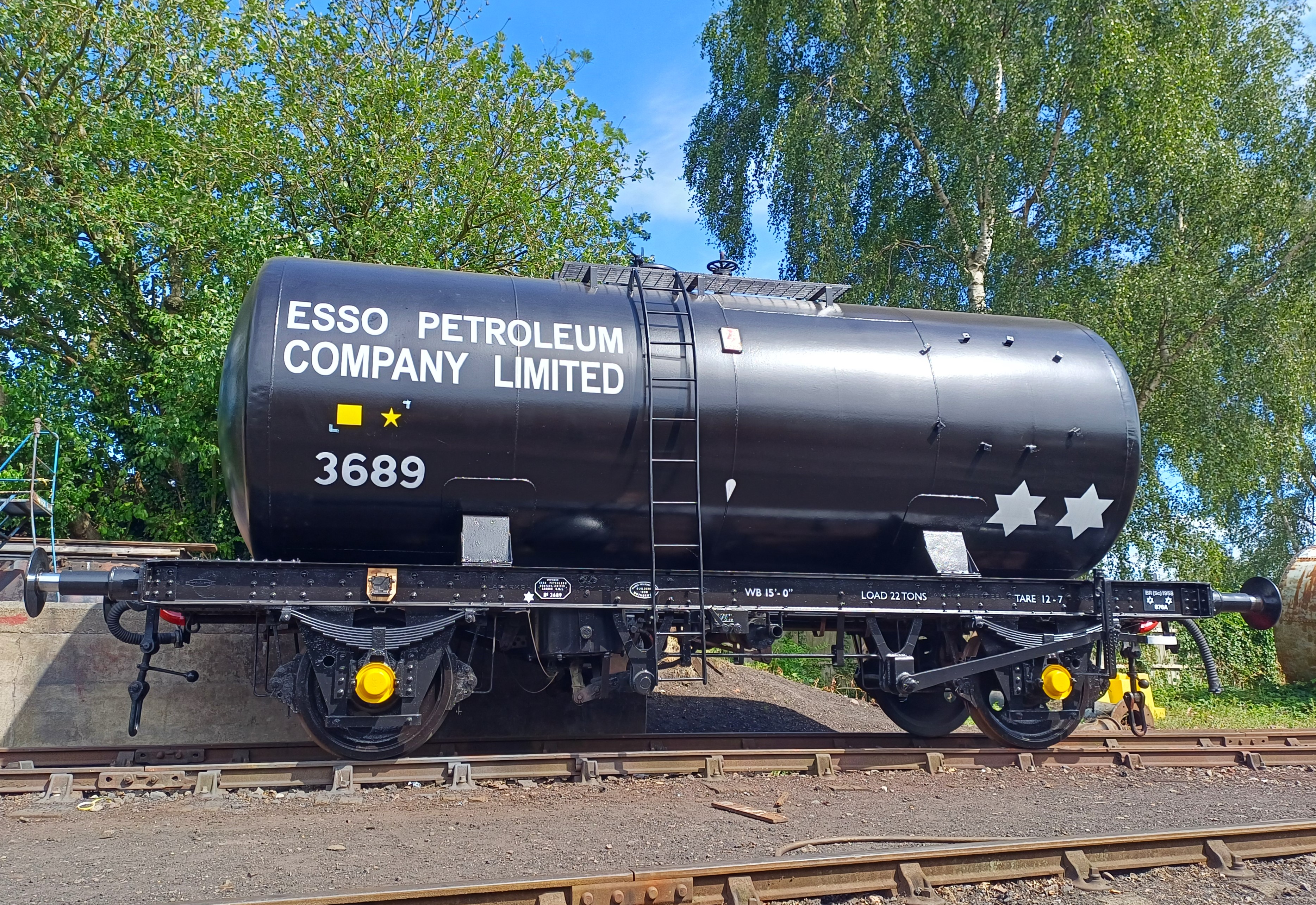
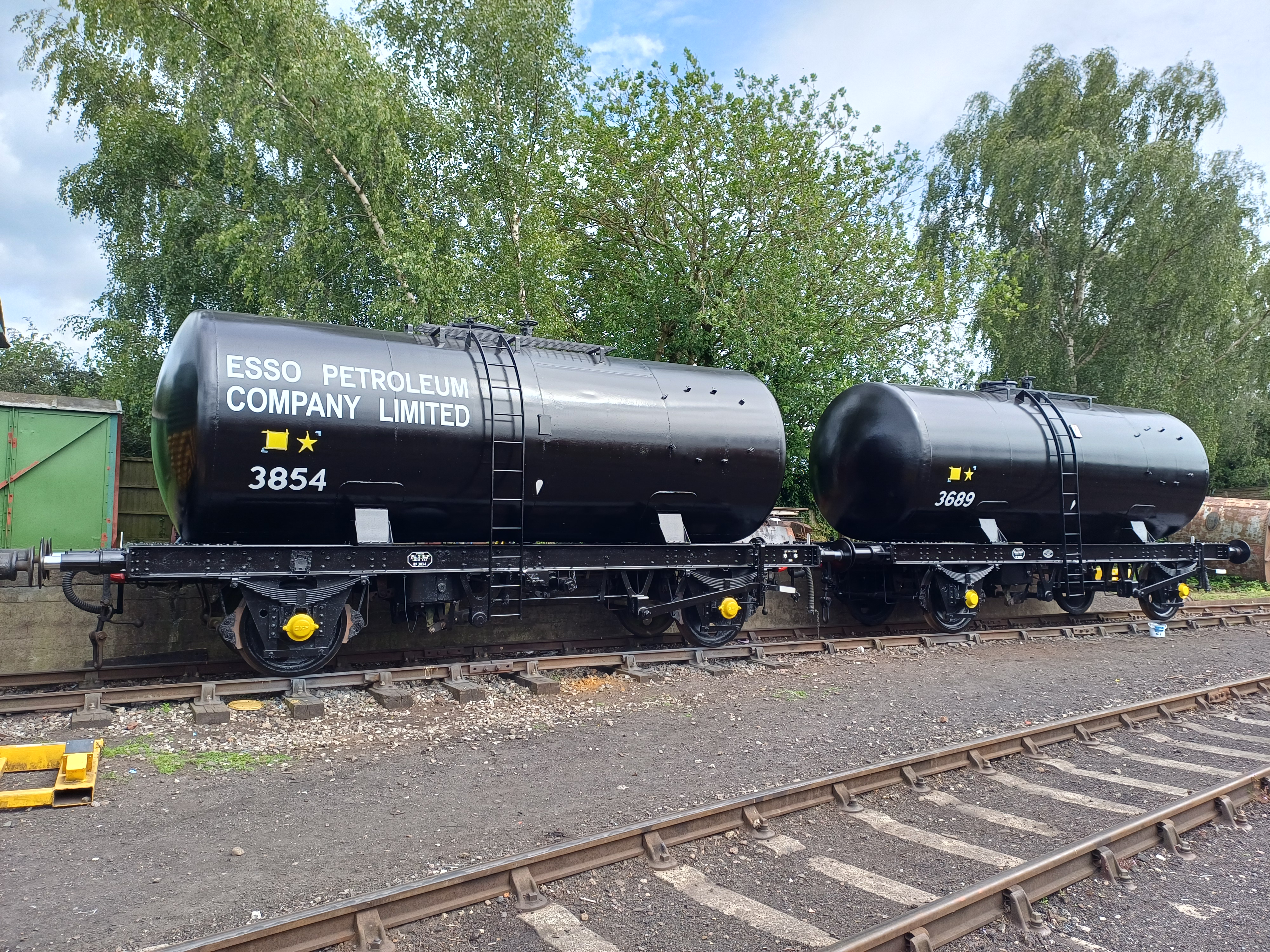
    Then continued with some needle gun work and red-oxide application on the underframe of tank 3689.

    Nick and Charlie turned their attention to the Lowmac wagon DE269001 that is needed for use by the P-Way team. The axleboxes and bearings were checked, oil levels topped up, oiled the brake rigging, a lamp iron replaced and an incorrectly fitted 3-link coupling replaced with a screw coupling which Ernie and Nick had spent some time freeing off and repairing.

    Ernie had previously measured up and done a drawing ready to help us manufacture some new floor hold-down noggins for Conflat B507489. Along with Oliver I set about selecting some well seasoned timber, extracting a few unwanted nails and marking out for cutting.

    Four pieces were cut to length then sliced to the correct width for the noggins. The rivet cut-outs were made then the mounting holes drilled.

    Each noggin was then checked for fit onto the wagon. These will be installed to hold the new floor down once we get the flooring wood.

    Further needle gunning was carried out on tank 3689, including some sanding, uncovering some of the east side solebar lettering; followed by some red oxide.

    And then some more red-oxide.

    The four Conflat noggins were given five coats of creosote / engine oil mix which was allowed to soak-in between each coat.

    Over the Easter weekend there was much tiding-up carried out over our whole work area, including the GUV. The interior of Test Car 2 was also tidied and the slip-end pipework re-assembled in readiness for our Diesel Gala opening at the end of the month. The guards area storage heater was sanded and given a first coat of white, and three new display boards were prepared and painted.

    Edward was treated to some new tyres that allowed him to be removed from the BEV stillage and put back onto his wheels, thus making him mobile .

    The BEV stillage was cleaned and de-greased then the bed repaired. This will make a very useful bench for welding projects.

    The spark guards from tank 3689 were cleaned up and checked, three of them will be suitable for re-use following some welding repairs, however the fourth will need to be replaced. Ernie and Nick made a start straightening, cutting out the rust and weld repairing.

    Another lamp repair was completed by Ernie including a coat of black gloss. And I made & fitted a brace bracket to the garage door chain-box in an attempt to stop the chain sprockets going out of line.

    A good start was made by Mark, Tom, Oliver, Dan and Charlie on the tank barrel paint removal from 3689. Approximately 1/4 of the tank barrel and one ladder being taken back to bare metal.

    Hector got a little embarrassed after suffering a puncture whilst on an errand down the yard; having to rely on a rather ignominious rescue by the Volvo. Following Ross’s inspection he found the inner tube of the front wheel had failed due to rubber rot!

    The Volvo came in useful again moving the bunded barrel pallet spill tank that we have been donated, to a safe place.

    We’ll leave you with a reminder that Test Car 2 will be open to visitors for the upcoming GCR Spring Diesel Gala 24 – 26 April.

    We still have the fantastic Great British Locomotives Models & Magazines Complete Collection for sale; forty one (41) OO Gauge Models with Magazines all in their unopened original packaging which is available as a rare complete collection.

    Please get in touch if you are interested, all proceeds will be used by the Quorn Wagon & Wagon group to directly assist with the continued restoration and maintenance of Test Car 2.

    Example Model & Magazine, GCR 506 Butler Henderson.

    Join us again soon for more Quorn Wagon & Wagon news, all the best, Dave

  • Vehicle Profile #10 – 21T Coal Hoppers

    Vehicle Profile #10 – 21T Coal Hoppers

    COAL HOPPERS


    The 21 Ton steel-bodied coal hopper was based on an LNER design and was the standard BR coal hopper until the advent of air-braked types such as the MGR wagons in the mid 1960s.

    The first lot was built at BR Shildon works in 1949, however subsequent wagons were built by Cravens, Head Wrightson and Metro-Cammell as well as BR Shildon. Over 23,000 wagons were eventually built by 1959, making them one of the most numerous types on the network.

    Most of the wagons were rebodied at least once, to a simplified design with fewer ribs as shown by the diagram below, while over a third of the fleet eventually gained vacuum brakes.

    Coded HTO and HTV under TOPS, the wagons were never fully replaced by air braked wagons but colliery closures had a major impact on their numbers. The unfitted fleet had all been withdrawn by the mid 1980s while just a handful of the vacuum braked HTVs made it into the 1990s.

    A number of the withdrawn fleet survived longer as internal use wagons at various steel works; although like our example B425356 that was retained at BSC Lackenby, many had their vacuum brake equipment removed.

    After withdrawal over 2000 of the 21 Ton hoppers were retained by BR for later modification into engineers fleet wagons.

    The initial modifications were coded as ZDV ‘Tope’ spoil wagons in 1984, the work involving sealing the bottom doors and reducing the height of the hopper, but retaining the vacuum brakes with the cylinders on the end of the wagon. Further conversions followed in 1987 and from 1989 a large programme of modifications and re-bodying started using the former 21 Ton hopper fleet. As well as further converted hopper body ‘ZDV (later ZCV) Tope’ wagons, ‘ZCV Clam’ and ‘ZBA Rudd’ types appeared with new box bodies fitted to the 21 Ton underframes that were intended to replace the ageing Grampus wagon fleet. The Clam wagons had fixed sides with the vacuum brake cylinders being moved underneath the wagon; whereas the Rudd type wagons had 3 dropside doors and were fitted with air brakes. We have three such Rudd wagons in our fleet at Quorn Wagon & Wagon, DB972018, DB972608 and DB972681.

    Over 800 Tope wagons, 450 Clam type and 800 Rudd type wagons were converted from 21 Ton hopper underframes at various works including Powell Duffryn, RFS Doncaster, CC Crump and Marcroft up until 1991.

    All the Tope, Clam and Rudd wagons had been withdrawn from mainline operation by 2008.

    Our Coal Hopper B425356 was and ex BSC Lackenby wagon, that was originally saved by the National Railway Museum at Shildon; it was subsequently bought by Nick Tinsley in June 2005 and came to the GCR where it was smartened up and lettered with House Coal Concentration around 20 years ago.

    The Quorn Wagon and Wagon team gave it a refresh restoration in 2023. At some point we will look into the possibility of re-fitting its’ vacuum brake system that was removed before preservation.

    B425356 Details

    Built                                       Head Wrightson 1957

    Type                                      Coal Hopper

    Other numbers               H50

    TOPS                                     HTP

    Diagram number             1/146 as built. Rebodied 1970s to 1/147

    Lot number                        3033

    Capacity                               21T

    Wheelbase                         12ft

    Condition                            Operational, restored Feb 2023

  • Vehicle Profile #9 – INSUL-FISH Vans

    Vehicle Profile #9 – INSUL-FISH Vans

    The British tradition of Fish & Chips began in 1860s, there were over 25,000 fish and chip shops by 1910 increasing to 35,000 at their peak in the 1930s. To meet the demand for fresh fish around the country the railway stepped in with fast fish expresses moving between ports and markets usually hundreds of miles apart. To keep them fresh fish were packed in boxes with ice and conveyed in insulated vans.

    The British Railway’s Insulated Fish Van (INSUL-FISH) was based on a LNER pre-nationalisation design; a total of 1,058 BR fish vans were built at the Faverdale Works in Darlington, County Durham. 500 to diagram number 800, and 558 to diagram number 801. There were minor differences between each of the builds, however they were all XP-rated with vacuum brakes and a through steam-heat pipe (allowing them to travel in passenger trains).

    A dedicated pool of 200 INSUL-FISH vans were specially maintained for the long distance traffic flow between King’s Cross Goods and Aberdeen. however, in order to reduce the risk of  hot-boxes a programme was initiated in 1957 to replace the plain journal axleboxes with Timken roller bearing axle-boxes. A total of 375 vans were eventually converted at Cowlairs, York, and Doncaster. The revised arrangement with roller bearing axles allowed speeds of up to 75mph; these vehicles were identified by the application of a large blue spot on the bodyside, which gave rise to the ‘blue spot’ nickname.

    The vans were originally painted white to reflect heat from the vehicle; however this colour did not weather well and due to complaints by the merchants selling fish that the public perceived these vehicles as filthy on the outside as well as inside. BR began using a different colour in 1963. This was known as Ice Blue.

    When the wet fish traffic by rail effectively ceased in 1968 the ‘blue spot’ vans were adopted for other use including parcels traffic being designated Special Parcels Vehicle (SPV). Many were painted in BR Blue and carrying the Express Parcels branding. Many also received the NRV designation under TOPS. Others were used as engineering vehicles and also barrier wagons. The last BR INSUL-FISH van in revenue service was reported to be in the Aylesbury area in 1981 whilst a number were retained and renumbered after this date as ‘internal user’ vans, such as E87706/ADW87706 which was also renumbered as an internal user 041475 for CCE use; captured by Dave Bower in 1981 at Shirebrook.

    At least 18 of these INSUL-FISH vans are in preservation, mostly those which had found their way into the internal user network, including 87706 which now resides at the Keighley & Worth Valley Railway, photo Dave Bower.

    A number of the INSUL-FISH van bodies also remain, grounded; including ours (87732) at Quorn.

    Our operational INSUL-FISH van E87674 was bought by Nick Tinsley in April 2000 from Crewe Pad Sidings, having been previously been used as a Departmental CCE Tool Van. The photo below is courtesy of Shawn Collier who captured 87674 at Beal St Siding, Leicester in 1988.

    We restored E87674 in 2018 into it’s mid 1960s Ice Blue livery, however although this vehicle would have carried a ‘Blue Spot’ being one of those converted to roller bearings; we haven’t applied this because unfortunately plain bearings were re-fitted when it was transferred to departmental use.

    E87674 is sometimes included in the van train at the GCR, however being the odd-man-out in it’s Ice-Blue livery, it is more often is seen in the Mixed Goods rake.

  • 08/03/26 – First Coat of Bauxite

    08/03/26 – First Coat of Bauxite

    Hello and welcome to this week’s news from Quorn. The Lowfit gets a first coat of Bauxite; Conflat-A B507489 had some attention, Tank 3689 progresses, and the lettering is completed on 3606’s Esso plates.

    The area where the water tower top had been moved from last week was levelled and more track ‘biscuits’ and clips were recovered. Charlie managed the bonfire to deal with the pile of scrap timber tidied from the area.

    The east side label clip was removed from tank 3689 as this was mounted in the wrong place so would be foul of the builders plate, and also it was mounted on an smaller wood block that standard.

    We took a look at Conflat B507489, and the jack-rust that had bent up the end kerb rails. An air-chisel and needle guns were used to clear out as much of the rust as possible from under the bent up sections of angle. The largest sledge hammer was then employed to flatten down level the kerb rail at both ends.

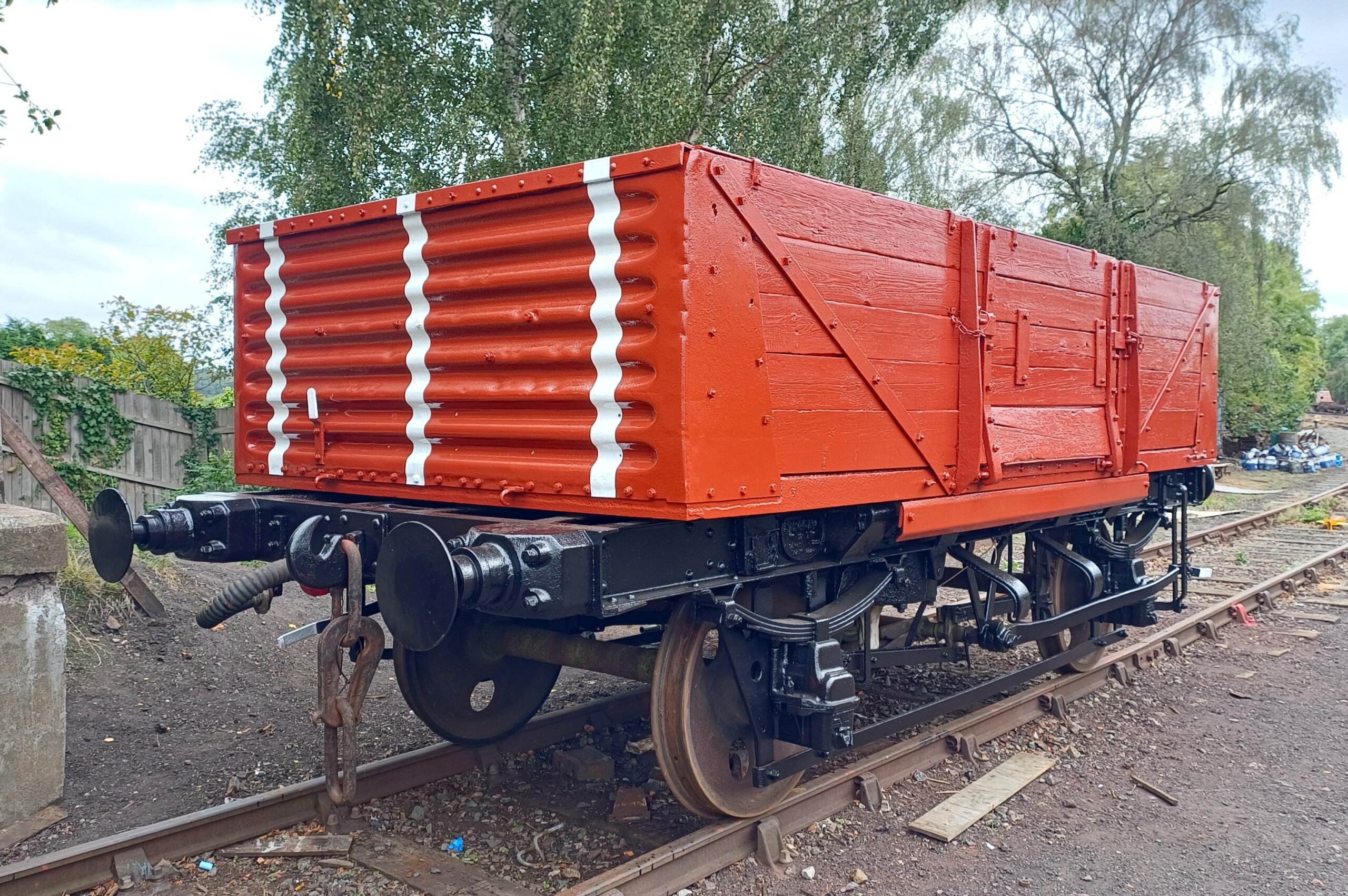
    The inside and outside of the Lowfit’s four doors were treated to their first coat of Bauxite Gloss.

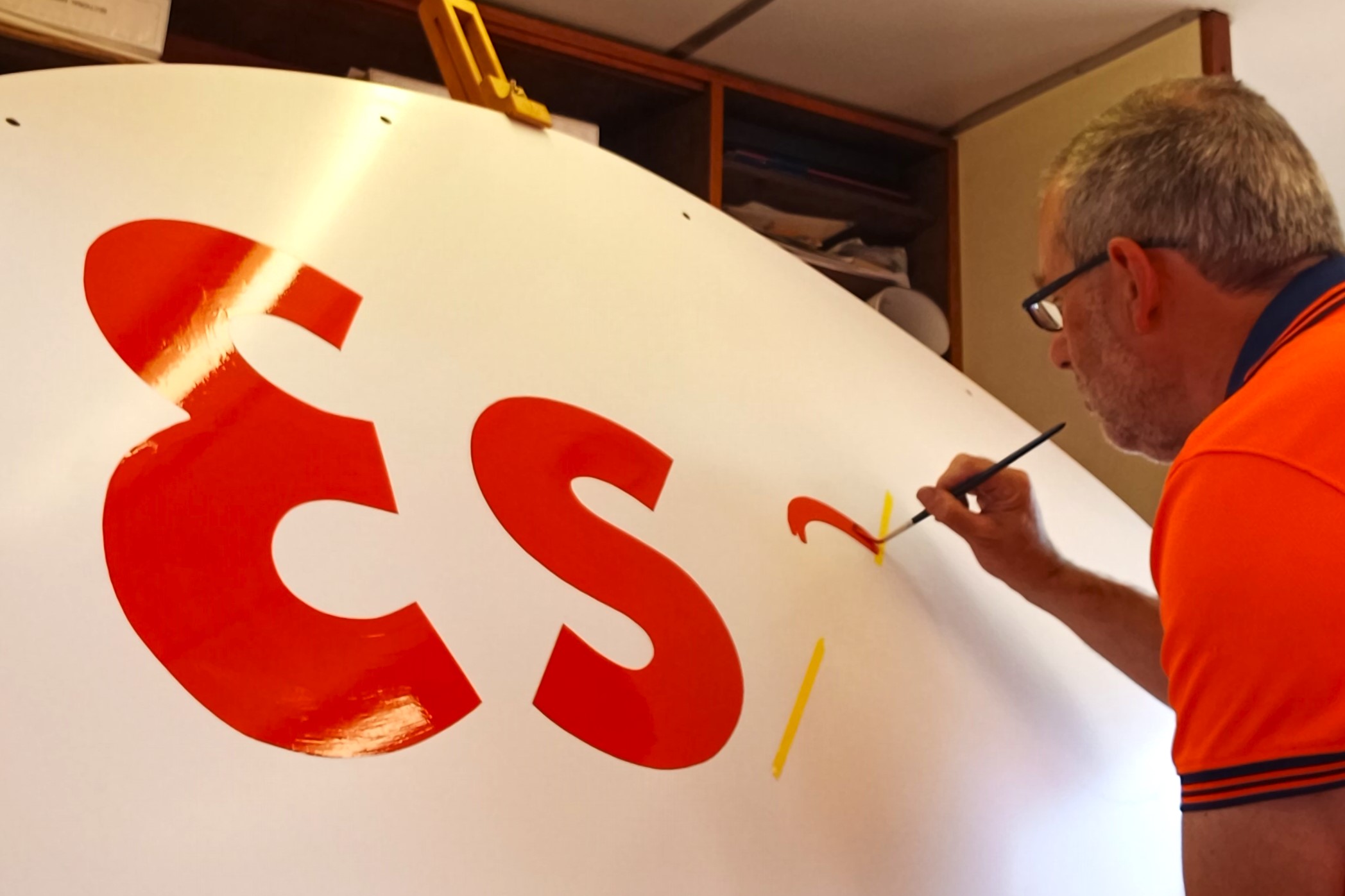
    The Red paint we had been using for the Esso plate lettering was previously not laying on evenly, not covering well and taking rather too long to dry; so after some searching we found some lettering Enamel of the correct colour. A test was done to check that the new paint would not react with the original, then Ross and myself applied the red lettering’s second coat to both of 3606’s Esso plates. The coverage was notably better and the paint had dried within a few hours. The next stage for these plates will be a coat of varnish.

    Ernie made a start on some lamp repairs to the Rothley shunter’s headlamp that lost it’s lens last week.

    Ross and myself then turned our attention to the west side solebar on Tank 3689; with needle guns out again about 3/4 of the solebar was cleaned up, and all the flaky paint removed back to bare metal, Ernie then followed applying some red-oxide primer.

    Nick touched up a few areas of the black gloss on the underframe of the Lowfit, and made a start on painting the inside of the kerb rails, again in black gloss.

    Whilst Ernie had the red-oxide primer out, he painted the inside of the vacuum cylinder piston he’d cleaned up last week.

    Thanks for reading, join us again next week, all the best, Dave
  • 22/02/26 – Lowfit gets some Paint

    22/02/26 – Lowfit gets some Paint

    Hi and welcome to our weekly update from Quorn. The Lowfit has received some paint, work continues on tank 3689, and 3621’s signwriting is completed.

    Mark, Tom, Oliver, Dan and Daniel did some more needle gun work on the underframe of tank 3689.

    Dan did some needle gun work and red-oxide painting on a vac cylinder dome.

    Charlie did some tidying up in the garage and some vac cylinders were put into storage. Ernie did some more lamp repairs.

    Nick did some cleaning out of rust from under the tank supports on 3689. He also installed the new first aid equipment and notices in our Mess Coach booking-on point.

    Mark, Dan, Daniel and Oliver took advantage of the warmer/dryer weather and got stuck in to applying red-oxide primer to the majority of the Lowfit wagon.

    I finished off the last couple of bits of signwriting on tank 3621.

    Charlie fitted a couple of the heater vents to the seat box sides in the Mess Coach.

    I painted 3621’s Esso plate attachment bolts in red-oxide, and when dry applied the blue.

    Ernie and myself dropped the doors and end panels on the Lowfit, wire brushed and applied undercoat the the insides of the doors.

    We then raised the doors and made a start applying undercoat to the door sides and ends.

    That wraps things up for this week, I’ll leave you with a pic of Standard 2 78018 steaming past our Mess Coach on her last day in service before withdrawal for overhaul.

    Join us again soon; all the best, Dave

  • 15/02/26 – Plates ON

    15/02/26 – Plates ON

    Hello and welcome to this week’s news from the team at Quorn. Tank 3621 is getting closer to completion, there is progress on tank 3689 and we continue with vacuum cylinder repairs.

    Charlie, Dan, James and Oliver did some site tidying-up.

    Mark and Tom continued with the needle gun work on tank 3689’s underframe.

    Oliver and Dan helped Nick remove the spark guards from tank 3689, this will allow access the underframe areas below, and also to clean up and make any repairs to the spark guards.

    I applied the Commuted Charge Cc logo to both sides of 3621.

    Ernie continued with the vacuum cylinder weld repairs, with Ross helping pressure test each stage of work; the soap solution highlighting any small pinholes which were then dealt with.

    The heater was put-on for a while in Test Car 2, and the previously sign-written Esso logo plates were given a light key over the front surface. Ross and I then applied a coat of gloss varnish which was left to dry overnight.

    Dan cleaned up the first of the vacuum cylinders to have it’s repairs completed and tested. He then applied a coat of re-oxide primer.

    Ernie continued with the second vacuum cylinder, welding and low-pressure testing for leaks. The cylinder held the low-pressure for a couple of hours confirming successful completion of the repairs.

    The Empty/Load changeover symbol was applied to the east side of tank 3621.

    The weather wasn’t kind to us on Sunday, however in between the showers Ross & I managed to fit the two varnished Esso plates to 3621; whilst Ernie made a start on some lamp repairs.

    We set up the next two Esso plates in Test Car 2 and gave the surface a light key ready to receive their sign-written logos.
    These two plates will be fitted to tank 3606 once completed.

    Thanks for reading, join us again next week; all the best, Dave

  • 18/01/26 – The Heat is ON

    18/01/26 – The Heat is ON

    Hello and welcome to our this week’s news from Quorn. Work continues on two of the tanks, the lowfit, two vacuum cylinders and we get the diesel heater working in the mess coach.

    The power switch and circuit breaker for the heater were installed into a 3d printed panel that Ross set into the end panel in the mess area. A temporary warm air outlet was fitted to the end of the heater, and under the coach the fuel pump was fitted & plumbed up to a temporary fuel arrangement. After a little challenge bleeding the system and changing the feed pipe to a smaller diameter tube, the heater was powered up and has performed admirably over the weekend keeping the mess-area nice and warm. The next stage will be to fit the under seat ducting for the air inlet and warm air outlets, & finishing off the fuel supply arrangement.

    Mark, Tom, Oliver and Daniel progressed bodyside and underframe paint removal from the Lowfit using needle guns and scrapers. Red oxide primer was then applied to the prepared areas.

    After drying off the overnight rain from tank 3621, Dan and myself completed some signwriting. Dan looking after a registration plate, tare and load text; and myself doing the east side Esso Petroleum Company Limited tank barrel text.

    Ernie continued with final areas of welding and cleaning up the two repaired vacuum cylinder domes. The 21″ one also receiving a coat of primer.

    After applying a little heat, Nick straightened up the bent lamp bracket on tank 3689.

    The mess coach table tops have been attempting to part company from the tables for some time, so Charlie and Ross set to work carefully removing the Formica panel from the worst affected table. The remains of the glue was then scraped off the table surface and the underside of the Formica with a little heat-gun help.

    The overhead warning flash plate that had to be removed from one side of tank 3854 last year (to allow for the Esso text), was repaired and re-fitted in the normal position in the centre of the wagon. To do this some additional length was welded onto the plate lugs, which were then dressed before the the plate was welded into place.

    Two birthday cakes were dealt with in the normal manner (being devoured very quickly). James’s cake went that quickly there was no chance of a picture, and very little of mine was left by the time this snap was taken….lol.

    Thanks for reading, join us again next week, all the best; Dave.

  • 04/01/26 – Varnished Van

    04/01/26 – Varnished Van

    Hello and welcome to this weeks update covering work at Rothley and also back at Quorn.

    The last few days of 2025 saw the final stages of painting, lettering and varnishing of Vanfit B777728 at Rothley.

    The east side solebar was black glossed by Nick and Charlie, whilst Ernie cleaned up and painted the vacuum pipe swan-necks & handbrake lever ends.

    I prepared the signwriting templates and chalked up the east bodyside ready for applying the running number and wagon details.

    The re-assembled vacuum cylinder was re-fitted to Palshoc Van B855568; and one of the springs was removed to be used as a pattern for making some replacement ones. In order for the van to remain movable a temporary spring was fitted in its place.

    The spare axleboxes that were removed from the old wheelsets of the Palshoc chassis were cleaned and the nuts/bolts removed before the parts were put into store. Some of the nuts needed a little heat persuasion to release.

    Whilst Nick varnished the west bodyside; I applied the running number and bodyside lettering to the east side of B777728; along with what will be the last use of the 2025 paint symbol.

    The west side solebar Builders Plate was then chalked up and painted on, along with the vacuum release star.

    Into 2026 and some of the team returned to Quorn whilst Mark, Ross and myself put the finishing touches to B777728 at Rothley.

    The east bodyside and van ends were varnished.

    The east side solebar Builders Plate and vacuum release star were applied.

    The rest of the team at Quorn removed one of the defective leaf springs from tank 3621 which was taken to Rothley, This will be sent away with the Palshoc springs as a pattern for replacements to be made.

    Tom got stuck in to picking out the Esso Owners Plates lettering and completed all 8 of the plates that will be fitted in due course to 3606, 3621, 3854 and 3689.

    The plates picked out by Tom for 3621 were fitted by Nick on Sunday. Unfortunately due to the cold weather not a lot else could be done outside.

    Ross made a start fitting a diesel heater to the mess coach, cutting out a floor aperture for the burner air inlet and exhaust and bolting the mounting plate and heater to the floor.

    That winds up our work this week, we’ll keep looking at the forecast hoping for warmer weather next weekend so that we can progress with our projects. Thanks for reading!

  • 28/12/25 – A couple of Noggins at Rothley

    28/12/25 – A couple of Noggins at Rothley

    Hi, Seasons Greetings and a warm welcome to our BETWIXTMAS update from the Team at Quorn as we continue with work at Rothley.

    After buffer shank cleaning, oiling up and final inspection, tank 3606 departed Quorn on the 22 December to join the rest of the tank train at Swithland.

    Tanks 3621, 3854 and 3689 were also shunted into the dock at Quorn ready for when we return to work there in the New Year.

    At Rothley work continued on B777728, with Charlie and Nick fitting the repair sections to the roof edges, and the roof sheet was slid into position.

    Saturday 27th, Mark, Dan, Tom and Oliver got to work with the east body side, which was scraped and sanded and a few patch filler repairs completed. The metalwork was then given a coat of primer.

    The body ends were scraped and wire brushed, then primed.

    Meanwhile myself and Ross cleaned up and primed the roof hoops.

    The team took a break for a ride on a Betwixtmas service train to enjoy a fabulous Griddle Car breakfast.

    Back to work, Charlie and James made a start disconnecting the vacuum cylinder on Palshoc Van B855568. The brake rigging was also disconnected on the west side in preparation for cylinder removal.

    Ross and myself trial fitted the roof end hoops, then removed them to apply sealant before bolting them into place and the sealant edges were wiped to give a neat finish.

    The roof sheet ends were then trimmed neatly.

    Mark, Oliver, Tom and Dan applied undercoat to the east side of B777728.

    Ross and myself then helped with the vacuum cylinder removal from the Palshoc. Some stubborn brake rigging needed a little hammer persuasion, and the inner trunion needed a little heat to free it off.

    Sunday, Tom and Oliver applied gloss Bauxite to the east body side and both ends of B777728.

    Ross and myself stripped the damaged studs from the Palshoc’s vacuum cylinder and removed the piston rod nut to allow easy cleaning out of the threads; whilst Nick cleaned up the piston rod.

    Ross and myself then trial fitted the two new door top noggins to B777728, this enabled us to mark-out a couple of slight modifications needed to allow the noggins to clear some bodyside frame bolts. A router was used to carefully cut recesses to clear the bolts and also for the door lock bar / retaining plate.

    Once the noggins were routed out we were able to mark-out and drill the eight locating bolt holes.

    Tom and Oliver cleaned up the flaking surface of the solebars on B777728 which had previously been painted with bitumen paint. Unfortunately we are are finding that after a few years, the bitumen paint that we used on a few wagons is not lasting very well. We’ve since reverted to using Black Gloss, of which a coat was applied to the west side and both ends.

    The noggins and retaining plates were given a final trial fit before removing to allow painting. Nick also cleaned up the trunion mounting plate for the Palshoc.

    That wraps up our Christmas week working at Rothley; join us next for a look back over the last 12 months as we head towards 2026.

    Best wishes for your New Year celebrations, and a reminder that you can see in the New Year on-board the GCR’s Nightrider train, more details here – “Nightrider”
    cheers, Dave.

  • 14/12/25 – Cuthbert and some Turkey

    14/12/25 – Cuthbert and some Turkey

    Hello and welcome; this week we have been busy with the Tanks, the Lowfit, and a vacuum cylinder, in between celebrating and some festive feasting.
    Nick is recovering (on light duties) this week after an operation; however it didn’t stop him celebrating his Birthday with Cuthbert the Caterpillar.

    Saturday, James and myself used paint removal discs to clean off the white paint from the tyres of tank 3854. A coat of black was then applied.

    Charlie & Ernie meanwhile made a start making a blanking plate for the repaired 21″ vacuum cylinder so that we could pressure test the cylinder repairs. The plate was cut, the edges ground up, mounting holes marked and drilled out. A centre hole was also drilled ready for the pressure fitting.

    The cylinder studs were run down with a die-nut to clean the threads and a boss was welded to the plate to take the pressure fitting.

    Once the sun had raised the temperature a bit, I was able to start applying the running numbers to tank 3621.

    James applied a coat of black to the Owners plates for tanks 3606 and 3621.

    On Sunday, Ernie, Charlie and Ross fitted the air test gauge and pipe to the blanking plate, then the plate was bolted to the vacuum dome using an old rubber cylinder seal in the joint.

    The air supply from Edward was coupled via a valve; then raising the pressure slowly to around 20psi and using some washing up liquid solution, we were able to see a couple of pin-hole leaks in the weld repair around the top of the dome. These were ground back and re-welded.

    Mark, Tom, Harry and Oliver continued with the Lowfit scraping and needle gunning work started last week.

    I busied myself with some solebar lettering on tank 3621.

    Sunday lunchtime, and our Chefs Mark & Tom treated us all to some festive Turkey & Duck baguettes, with trimmings of course.

    Followed by crackers!

    After a rather extended lunch-break, work continued with some red oxide being applied to the areas cleaned up on the Lowfit.

    A coupe of final jobs were attended to on tank 3606, including securing the new brake rigging split pins, removing the operating link from the redundant vacuum cylinder and securing the cylinder to prevent rotation by making and fitting bracket between the cylinder and the underframe. Once the vacuum release chords are fitted, tank 3606 will be ready for handover to the C&W Department for final inspection before entering traffic.

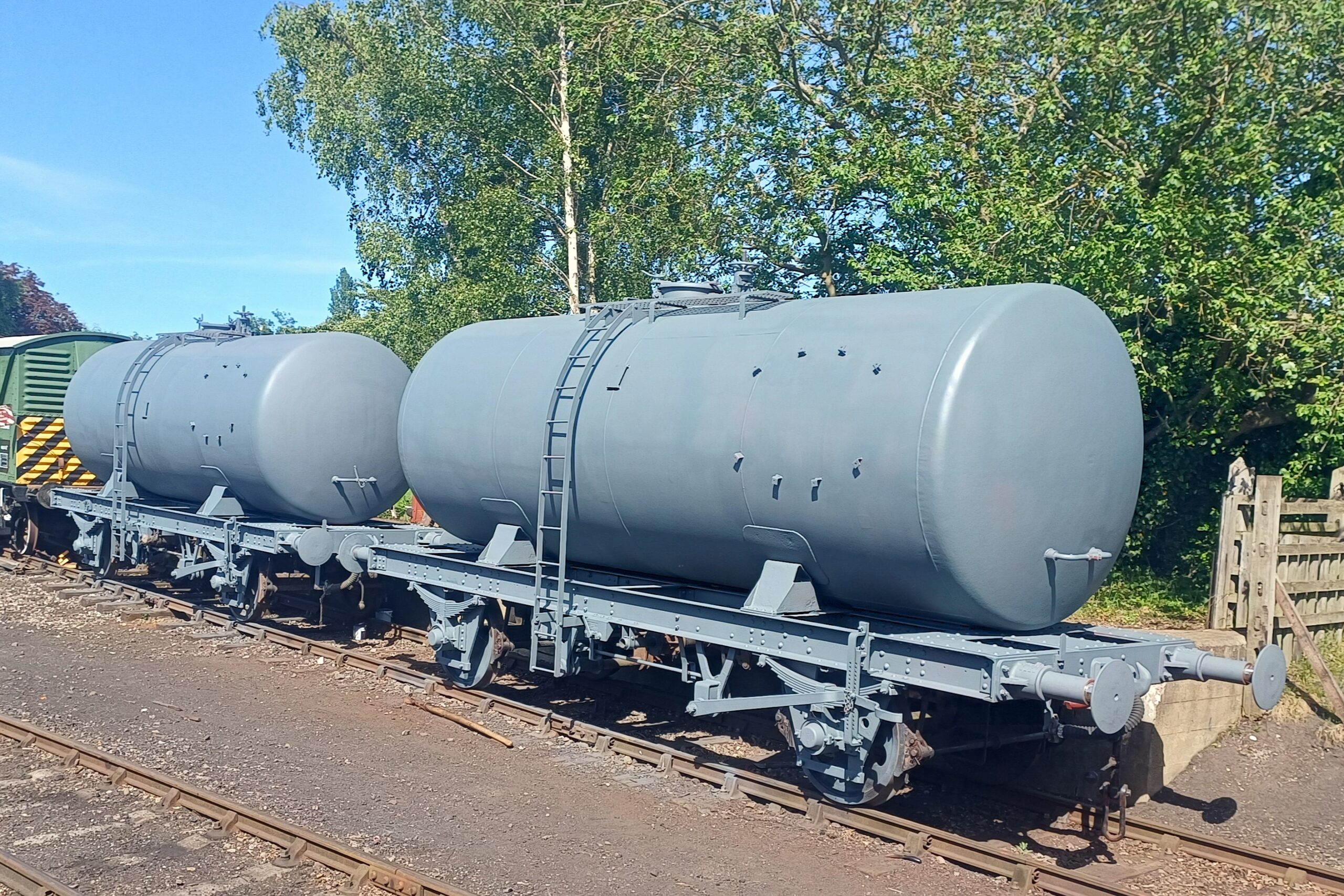
    Join us again next week, in the meantime I’ll leave you with pics of the Tanks and Lowfit; all the best, Dave